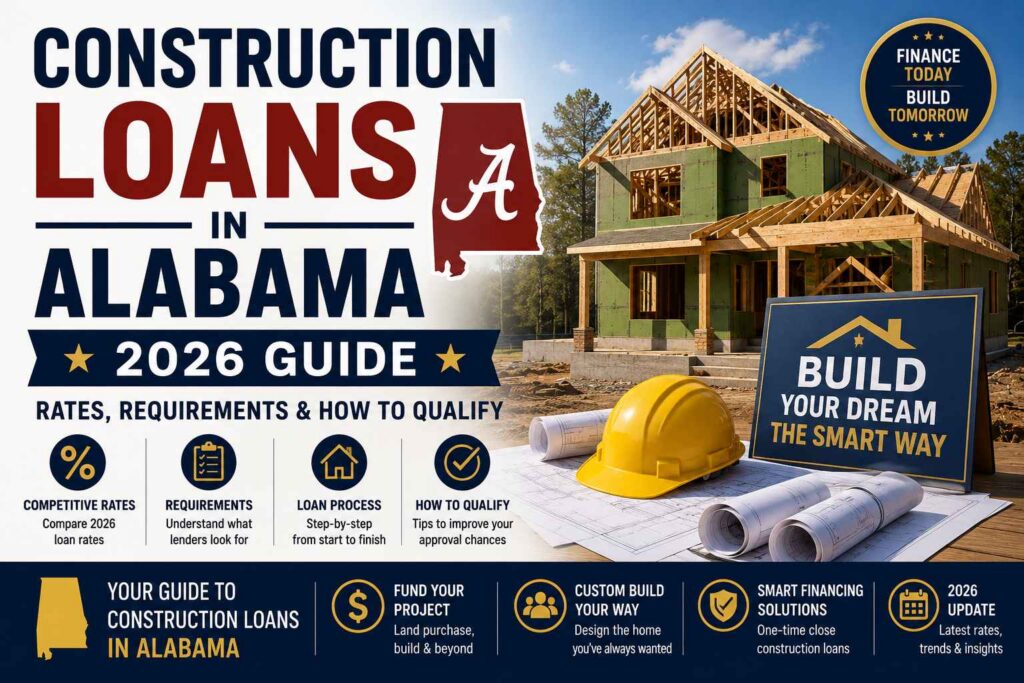
Thinking about building a home in Alabama? It’s a big step, and figuring out how to pay for it can feel overwhelming. Traditional mortgages usually finance homes that are already complete, while construction loans finance the building process before the home is finished.
These loans are specifically designed to cover the costs of building your new house, from the foundation to the roof. This guide explains the basics of construction loans in Alabama, including common requirements, loan types, costs, and lender expectations.
What is a Construction Loan?
So, you’re thinking about building a house here in Alabama? That’s exciting! But before you start picking out paint colors, you’ll need to figure out the financing. That’s where a construction loan comes in. Think of it as a short-term loan specifically for building your new home. It’s different from a regular mortgage you’d get to buy an existing house. Instead of handing over a lump sum, the lender gives you the money in stages, called draws, as the construction progresses. This helps make sure the project stays on track and within budget.
These loans cover the costs of building, and sometimes even the land if you don’t own it yet. Because there is more risk involved for the lender, the house is not built yet, they usually require a larger down payment. For many conventional construction loans, down payments can be around 20% or more, although government-backed options may allow lower down payments.
There are a couple of main ways these loans work:
- Construction-Only Loans: These cover just the building phase. Once the house is finished, you’ll need to get a separate, permanent mortgage to pay off the construction loan. It’s like two separate steps.
- Construction-to-Permanent Loans: This is a popular option because it combines everything into one loan. You get financing for the build, and then it automatically converts into your regular mortgage once construction is done. This means only one closing, which can save you time and money. This simplifies the process quite a bit.
During the construction period, you’ll typically make interest-only payments on the money you’ve drawn so far. Once the house is complete and you’ve moved in, your payments will switch to cover both principal and interest, just like a normal mortgage. It’s a bit of a different process, but it’s how most new homes get financed.
Types of Construction Loans in Alabama
When you’re looking into financing a custom home in Alabama, you’ll find there are a couple of main ways lenders handle construction loans. It’s not a one-size-fits-all situation, and understanding these differences can really help you pick the right path for your building project.
Construction-to-Permanent Loans
This type of loan is pretty popular because it bundles everything into one package. You get the money to build your house, and then, once it’s finished, the loan automatically converts into your regular mortgage. It’s often called a “one-time close” loan.
This means you only go through the closing process once, which can save you time and a bit of money on fees. It’s a great option if you’re planning to live in the home long-term and want to simplify the whole process of getting your new home built. Lenders like this because it streamlines things, and borrowers appreciate the convenience. It’s a solid choice for many looking for new home construction financing in Alabama.
- Combines construction and mortgage financing.
- Requires only one closing.
- Simplifies the process and can reduce costs.
- Rate is locked in upfront, protecting against market changes.
A construction-to-permanent loan is a smart way to handle building a house loan in Alabama, especially if you want to avoid the hassle of refinancing later. It offers a clear path from breaking ground to moving in.
Construction-Only Loans
Then you have construction-only loans. These are more like a short-term loan that covers just the building phase. Once your house is built, the construction loan is paid off, and you’ll need to get a separate, traditional mortgage to finance the home. This might be a good option if you’re not sure about your long-term plans or if you plan to sell the home shortly after it’s built. It gives you flexibility, but it does mean you’ll have to go through a second closing process for the permanent mortgage. This is a common route for new home construction mortgages in AL.
- Covers only the building period.
- Requires a separate mortgage after construction.
- Offers flexibility for short-term plans.
- May involve two separate closing processes.
Choosing between these two really depends on your personal situation and what you plan to do with the home after it’s built. Both are valid ways to get your dream home constructed, whether you’re looking at financing a house build AL or a more traditional site-built home.
VA Construction Loans
For eligible veterans and active-duty service members, the VA One-Time Close Construction Loan is the most powerful option available. It combines construction financing and permanent mortgage into a single closing with zero down payment required, no PMI, and no double fees. Alabama has a strong military presence across its bases, and VA loans in Alabama cover the state-specific program details veterans need to know.
USDA Construction Loans
If you’re building in a rural area of Alabama and meet income requirements, the USDA construction loan program may offer favorable terms with low or no down payment. Alabama has significant rural areas where USDA eligibility applies. worth exploring if your building site is outside major metro areas.
Alabama Construction Loan Requirements
Getting a construction loan in Alabama involves a few key things lenders will look at. They want to make sure you and your project are a good bet. Think of it like this: they’re investing in your dream home, so they need to see a solid plan and a reliable person behind it.
Credit Score and Financial History
Lenders will definitely check your credit report. A good credit score shows you’ve managed debt responsibly in the past. While there’s no single magic number for all Alabama builder loans, explained. Some programs may allow scores around 620, but many conventional construction lenders prefer stronger credit, often around 680 or higher. ).
This is basically how much you owe each month compared to how much you earn. A lower DTI means you have more room in your budget for a new loan payment. They want to see a history of stable income, too, so expect to provide pay stubs and tax returns. Reviewing the minimum credit score for a VA loan shows that VA-approved lenders are typically more flexible on credit than conventional lenders.
Down Payment and Equity
Most home construction loan requirements in AL ask for a down payment. For conventional construction loans, down payments commonly range from about 10% to 25% or more, depending on the lender, borrower profile, and loan program.
The lender also needs to feel confident that the finished home will be worth at least the amount of the loan. This is where the appraisal comes in, looking at the projected value after construction.
Builder and Project Details
This is a big one for AL construction loan requirements. You can’t just pick anyone to build your house. Lenders typically require you to work with a licensed and insured builder who has a good track record. They’ll want to see detailed plans for your home, including blueprints and specifications. A thorough budget outlining all costs, from land and materials to labor and permits, is also a must. This helps them understand the scope of the project and ensures everything is accounted for.
For custom home loans in Alabama, the builder’s experience and the completeness of your project plans are just as important as your personal finances. A well-defined project reduces risk for everyone involved. Understanding financing home construction paperwork ensures you know what documentation your lender requires at each construction stage.
Here’s a general idea of what lenders look for:
- Credit Score: Aim for 620+, ideally 700+.
- Debt-to-Income Ratio (DTI): Generally below 43%, but lower is better.
- Down Payment: Typically 10-20% of the total project cost.
- Builder Qualifications: Licensed, insured, and experienced.
- Project Documentation: Detailed plans, blueprints, and a comprehensive budget.
- Proof of Funds: For any costs not covered by the loan, like the down payment and initial fees.
How to Qualify for a Construction Loan in Alabama
Getting approved for a construction loan in Alabama involves a few key steps and meeting specific lender criteria. It’s not quite like applying for a regular mortgage, as lenders need to be sure you can handle both the building phase and the final home.
First off, your creditworthiness is a big deal. Lenders will look at your credit score, credit history, and your debt-to-income ratio. Generally, a higher credit score makes you a more attractive borrower. You’ll also need to show that you have enough cash for a down payment. The required down payment varies widely. Conventional construction loans often require more cash down, while FHA, VA, or USDA options may allow lower down payments for eligible borrowers.
Beyond your personal finances, the lender needs to see a solid plan for the house itself. This means providing detailed architectural drawings, a complete budget outlining all costs (materials, labor, permits, etc.), and information about the builder you plan to use.
Here’s a quick rundown of what you’ll typically need:
- Detailed Project Plans: Architectural blueprints and site plans.
- Comprehensive Budget: A breakdown of all anticipated construction costs.
- Builder Information: Proof that your chosen builder is licensed, insured, and experienced.
- Financial Documentation: Pay stubs, tax returns, bank statements, and a credit report.
- Land Ownership: Proof of ownership for the land where you’ll build, or a purchase agreement.
The lender will appraise the property based on its finished value, not just the land. This helps them determine the maximum loan amount and ensures the loan is in line with what the completed home will be worth. It’s also important to remember that for a one-time close loan, any changes you make to the plans after closing will need to be paid for out of pocket, as the loan is finalized before construction begins.
Construction Loan Interest Rates and Fees in Alabama
When you’re looking into a construction loan in Alabama, understanding the costs involved is pretty important. It’s not just about the final price of your new home, there are several fees and interest rates that add up during the building process. These costs can differ quite a bit from a standard mortgage.
Construction loans often have interest rates that are a bit higher than those for traditional mortgages. This is because they’re considered short-term loans and carry a different kind of risk for the lender. You’ll typically pay interest only on the funds you’ve drawn from the loan as the project progresses. So, if you’ve had $100,000 disbursed, you’ll pay interest on that amount, not the total loan. This can help keep your payments manageable during construction.
Beyond the interest rate, you’ll run into a few other fees. These can include:
- Origination fees: This is a fee charged by the lender for processing the loan, usually a percentage of the total loan amount.
- Appraisal fees: An appraiser will need to assess the value of your property, both now and once it’s completed.
- Inspection fees: Lenders will want to check on the progress of the build periodically.
- Title insurance: This protects the lender (and sometimes you) against any claims on the property’s title.
- Recording fees: These are government fees for officially recording the loan documents.
It’s also worth noting that some construction loans might require an interest reserve, which is an amount set aside to cover interest payments during the construction phase. This can sometimes be rolled into the total loan amount, but it’s something to clarify with your lender.
The specific rates and fees can vary significantly between lenders. It’s a good idea to get quotes from a few different places to compare. Don’t be afraid to ask questions about every single charge. Understanding these costs upfront will help you budget more accurately for your new home build.
When comparing offers, look at the Annual Percentage Rate (APR), which gives a more complete picture of the loan’s cost, including fees. Also, consider the loan terms and how interest is calculated. Some lenders might offer more flexible payment schedules during the build phase, which could be a big help. Finding a lender experienced with construction projects in Alabama can also make a difference in how smoothly the financial side of things goes. You can explore options for construction loans in Alabama to get a better sense of what’s available.
Finding the Right Lender for Your Alabama Construction Loan
Alright, so you’ve decided to build your dream home in Alabama, and you’re looking into construction loans. That’s a big step! Now comes the part where you need to find the right bank or lender to work with. It’s not just about picking the first name you see, different lenders have different ways of doing things, and some might be a much better fit for your specific situation than others.
Think of it like this: some lenders are really good with folks who already have a good chunk of equity in their current property, while others might be more geared towards first-time builders who are starting from scratch. It’s important to do a little digging. You’ll want to look for lenders who have a solid track record with construction loans, specifically in Alabama. Ask around, check reviews, and see if you can find recommendations from builders or real estate agents you trust.
When you’re talking to potential lenders, be prepared to share a good amount of information. They’ll want to see your credit history, proof of income, and how much debt you’re currently carrying. But beyond that, they’ll also need to see your detailed construction plans. This isn’t just a sketch, it needs to include architectural drawings, a breakdown of material costs, labor estimates, and a timeline. Having all this ready shows you’re serious and organized.
Here’s a quick rundown of what to consider when comparing lenders:
- Experience with Construction Loans: Do they regularly handle these types of loans, or is it a rare thing for them?
- Loan Products Offered: Do they have construction-only, construction-to-permanent, or other options that fit your needs?
- Interest Rates and Fees: Get a clear picture of all the costs involved, not just the interest rate.
- Draw Schedule: How do they disburse funds during construction? Is it flexible?
- Local Presence: Sometimes, a local lender understands the Alabama market better.
Finding a lender who truly understands the ins and outs of construction financing can make all the difference. They can guide you through the process, offer advice, and help you avoid common pitfalls. It’s about building a relationship with a financial partner who’s invested in your project’s success.
Don’t be afraid to shop around. You might be surprised at the variety of terms and conditions available. Ultimately, the goal is to find a lender who offers competitive rates, clear communication, and a process that feels manageable for you. It’s a significant financial undertaking, so taking the time to find the right partner is definitely worth it. You can even look into options like FHA loans if you meet certain criteria, which can sometimes offer more flexible terms for building a primary residence.
Wrapping It Up
So, building a home in Alabama might seem like a big undertaking, and honestly, it is. But with the right construction loan, it can be a lot more doable than you think. We’ve looked at what you generally need to qualify, like having a solid plan and decent credit, and some of the different loan types out there, like the one-time close option that can make things simpler.
Remember, rates and terms can change, and every lender is a little different, so doing your homework and talking to a few loan officers is key. It’s about finding that right fit to help turn your Alabama building dream into a reality without too many headaches.
Frequently Asked Questions
What exactly is a construction loan?
Think of a construction loan as a special loan just for building a house. Instead of getting all the money at once like a regular home loan, you get the money in parts as the building progresses. It helps cover the costs of building your new home from the ground up.
Are there different kinds of construction loans?
Yes, there are! Some loans are just for the building part, and then you need a separate loan later to live in the house. Others, called ‘construction-to-permanent’ loans, combine the building loan and the regular home loan into one, making things simpler.
What do I need to get a construction loan in Alabama?
Lenders will want to see that you’re a good bet. This usually means having a decent credit score, a plan for how you’ll pay back the loan, and usually putting some of your own money down. You’ll also need details about the builder and the house plans.
How can I increase my chances of getting approved?
To get approved, make sure your credit is in good shape, and you don’t owe too much money already. Having a solid plan for the building project and showing you have some savings ready to go can also really help your case.
What about interest rates and fees for these loans?
Interest rates can change based on things like the economy and your own financial situation. There might also be fees for setting up the loan. It’s smart to shop around and compare offers from different lenders to find the best deal.
Why should I consider building my own home with a loan?
Building your own home can sometimes be more affordable than buying an existing one, especially if you plan to stay there for a long time. Construction loans offer flexibility and can help you create a home that perfectly fits your needs and style.