

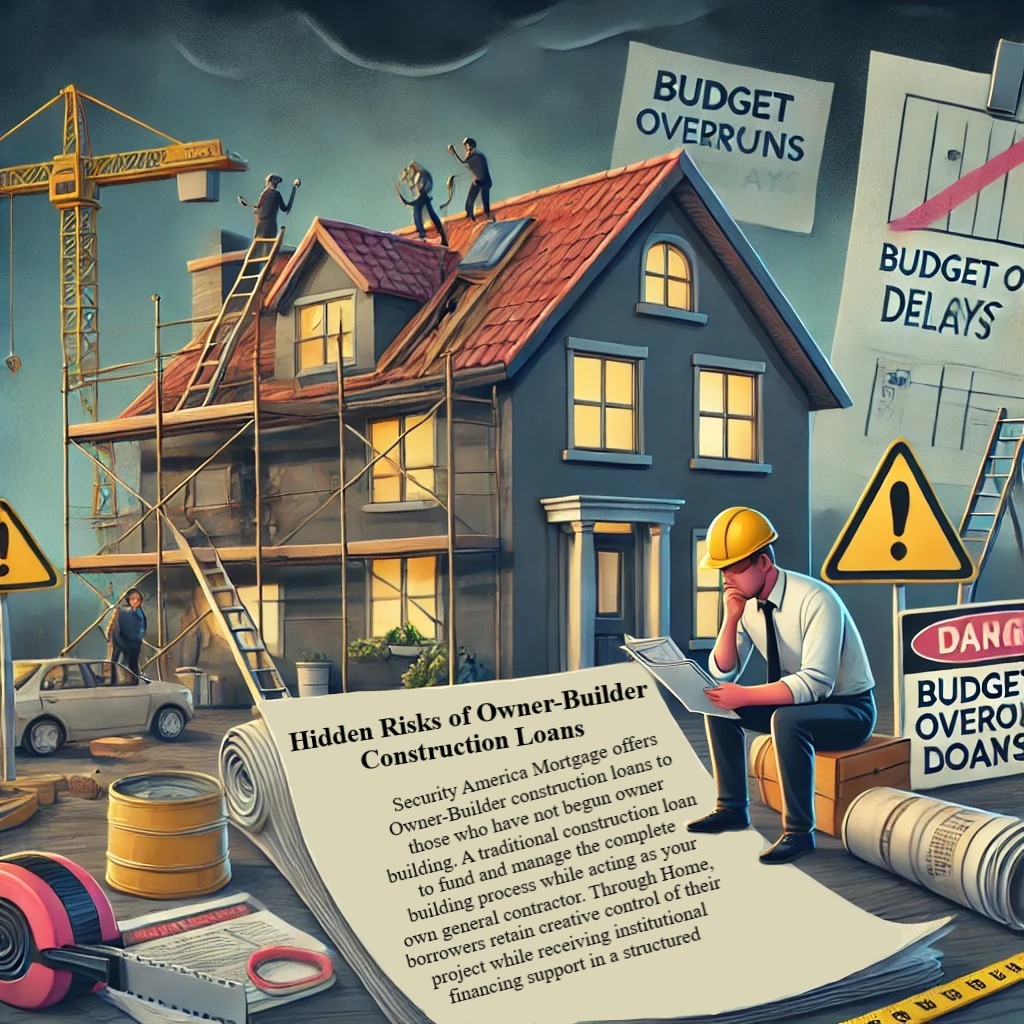
Owner-builder construction loans can look attractive because they give you more control over your home build, contractor choices, finishes, and budget. However, acting as your own general contractor also shifts major financial, legal, scheduling, and liability risks onto you.
Before choosing this path, you need to understand how construction draws work, why lenders require detailed documentation, and how delays or missed inspections can affect your cash flow. This guide explains the real risks of owner-builder financing in 2026, how to avoid common mistakes, and when a traditional builder-led construction loan may be the safer option.
Quick Answer: Are Owner-Builder Construction Loans Risky?
Yes. Owner-builder construction loans can be risky because the borrower is responsible for both financing and managing the construction process. The lender may require stronger credit, larger reserves, construction experience, approved subcontractor documentation, and a clear draw schedule before approving the loan. If the project runs over budget, misses a milestone, fails an inspection, or stalls because of permits or labor delays, the borrower may need to cover costs out of pocket while interest continues to accrue.
That does not mean every owner-builder project is a bad idea. It means the borrower must treat the build like a professional construction business rather than a weekend DIY project. The safest approach is to prepare a complete project plan, verify lender rules early, purchase the right insurance, build a realistic contingency fund, and use licensed specialists for technical trades like electrical, plumbing, HVAC, foundation work, and structural systems.
Understanding Owner-Builder Construction Loans
An owner-builder loan is a construction financing product for a borrower who wants to act as the general contractor on their own home. Instead of hiring one builder to manage the whole project, the borrower coordinates the schedule, subcontractors, bids, materials, inspections, and job-site communication. Because the lender is financing a home that does not yet exist, the loan is evaluated differently from a normal purchase mortgage.
The biggest difference is the draw system. Funds are usually released in stages as the home reaches approved milestones, such as foundation, framing, mechanical rough-ins, drywall, and completion. That means cash flow matters as much as the total loan amount. If a subcontractor needs payment before an inspection clears the next draw, the owner-builder may need enough reserves to bridge the gap.
Borrowers can also review how construction loans work when you own land before choosing this path.
How Owner-Builder Financing Differs From a Traditional Mortgage
A traditional mortgage is based on a completed home with a known value, while construction financing is based on plans, specifications, estimated costs, and future completion. This makes underwriting more documentation-heavy. The lender may want architectural plans, a construction contract or cost breakdown, a timeline, budget line items, land details, permits, insurance evidence, and information about the people doing the work.
Construction-to-permanent financing can be handled through one closing or two closings, depending on the lender and loan structure. A single-closing loan converts into permanent financing after construction, while a two-closing structure uses separate construction and permanent loans. Each structure has different cost, rate-lock, and timing considerations.
Each structure has different cost, rate-lock, and timing considerations, which is why many borrowers compare construction-to-permanent loans early in the planning process.
| Loan Type | How Funds Work | Main Risk for Borrower |
|---|---|---|
| Standard purchase mortgage | Funds are paid at closing for a completed home. | Risk centers on appraisal, title, credit, and income approval. |
| Construction-only loan | Funds are drawn during the build and later paid off or refinanced. | Borrower must qualify again or secure takeout financing. |
| Construction-to-permanent loan | Construction financing later converts into a mortgage. | Rate, completion, and inspection rules must be managed carefully. |
| Owner-builder loan | Borrower manages the build and draws are tied to milestones. | Lender risk is higher because project execution depends on the borrower. |
This comparison shows why owner-builder loans are usually more difficult than normal mortgages. The loan is not only about whether you can afford the monthly payment; it is also about whether the build can be completed on time, within budget, and to code. A borrower with strong income may still struggle if the lender does not trust the construction plan or the borrower’s ability to manage subcontractors.
The table also highlights why construction-only loans can be risky if the borrower assumes permanent financing will be automatic. If credit, income, interest rates, or property value change before completion, refinancing can become more expensive or harder to secure. For that reason, many borrowers compare one-time close and two-time close options before committing.
The Appeal of Owner-Building: Benefits vs. Hidden Risks
Potential Benefits of Building as Your Own Contractor
The appeal of owner-building is easy to understand. You may be able to choose your own subcontractors, control design decisions, avoid some general contractor markup, and make detailed choices about materials and finishes. For experienced builders, real estate investors, or tradespeople, this can create flexibility that a traditional turnkey build does not always offer.
The benefits are strongest when the borrower already understands scheduling, estimating, permits, contracts, and quality control. Without that background, the potential savings can be offset by mistakes, rework, delays, and poor subcontractor coordination. In other words, the owner-builder model rewards strong management, not just enthusiasm.
Why the Savings Are Often Smaller Than Expected
Many owner-builders assume they will save the full builder markup, but that is not always realistic. Professional builders often receive better pricing, faster scheduling, and priority access from suppliers and trade partners because they bring repeat business. An individual borrower may pay higher retail pricing, face longer lead times, or struggle to secure reliable labor during busy construction seasons.
Savings can also disappear when soft costs are underestimated. Permits, engineering, soil testing, surveys, utility connections, temporary power, dumpsters, portable toilets, re-inspection fees, change orders, and tool rentals are not small details. When these items are missing from the original budget, the borrower may be forced to use personal cash or cut corners later in the project.
A detailed guide on how much it costs to build a house can help borrowers plan beyond basic material costs.
| Hidden Cost Area | Why It Matters | Planning Tip |
|---|---|---|
| Site preparation | Clearing, grading, soil issues, drainage, and access can change the budget early. | Order surveys, soil tests, and site evaluations before finalizing the budget. |
| Utility connections | Water, sewer, septic, gas, electric, and internet costs vary widely by location. | Contact local providers before loan approval and confirm connection fees. |
| Inspection and draw fees | Construction loans often require inspections before funds are released. | Ask the lender how many draws are allowed and what each inspection costs. |
| Material escalation | Lumber, concrete, roofing, and mechanical systems can change in price. | Use current supplier quotes and keep a contingency reserve. |
| Rework and code corrections | DIY mistakes or failed inspections can require paid corrections. | Use qualified trades for technical and safety-critical work. |
A hidden-cost table is only useful when it becomes part of your actual budget. Before applying for financing, separate hard costs from soft costs and list every professional fee, permit fee, site cost, inspection cost, and allowance. If an item is uncertain, treat it as a risk rather than assuming it will stay low.
Lenders may also require evidence that you have enough cash reserves beyond the loan amount. This protects both the lender and the borrower because a half-finished home creates a serious financial problem. If your budget only works when every line item stays perfect, it is not a strong owner-builder budget.
Key Hidden Risks of Owner-Builder Construction Loans
1. Stricter Lender Approval Standards
Owner-builder loans are not offered by every lender because the risk profile is higher than a builder-managed project. A lender may ask for stronger credit, a larger down payment, more reserves, detailed building plans, proof of construction knowledge, and evidence that licensed professionals will complete specialized work. Some lenders may simply decline owner-builder applications unless the borrower has documented construction experience.
This is especially important for borrowers comparing conventional, portfolio, or VA-related construction financing. VA construction loans are available through participating lenders, but they involve stricter documentation and lender participation rules. Veterans should confirm early whether the lender allows true owner-builder structures or requires an approved or professionally qualified builder.
Veterans should confirm early whether the lender allows true owner-builder structures or requires an approved or professionally qualified builder through a VA construction loan program.
2. Draw Schedule Problems and Cash-Flow Gaps
A construction draw schedule is the lender’s system for releasing money after specific work is completed and inspected. This protects the lender from releasing all funds before the home exists, but it can create pressure for the owner-builder. If a subcontractor requires payment before the draw is approved, the borrower may need to front the money from personal reserves.
Draw delays can happen because of inspection backlogs, incomplete work, missing invoices, unclear lien waivers, failed inspections, or document errors. Even a short delay can affect the next trade in the schedule. That is why an owner-builder should know the lender’s draw policy before signing contracts with subcontractors.
This is one reason borrowers should understand construction loan requirements before starting.
| Draw Stage | Common Lender Review | Owner-Builder Risk |
|---|---|---|
| Foundation | Inspection, invoices, lien documentation, and site progress. | Delay can stop framing and increase interest carry. |
| Framing | Progress inspection and verification that work matches plans. | Material changes may require lender or permit updates. |
| Mechanical rough-ins | Electrical, plumbing, HVAC, and code inspections. | Trade errors can trigger costly corrections before the next draw. |
| Drywall/interior | Completion percentage and remaining budget review. | Budget overruns become more visible at this stage. |
| Final completion | Final inspection, certificate of occupancy, and appraisal completion. | Unfinished punch-list items may delay conversion or payoff. |
The draw schedule should be built into your project calendar from the beginning. Do not schedule subcontractors based only on ideal construction speed; schedule them around inspection timing, draw request timing, and realistic payment release dates. If the lender normally takes several days to release funds, your contracts and cash reserves should reflect that delay.
A strong owner-builder plan includes a separate cash-flow worksheet. This worksheet should show when each trade expects payment, when the lender draw is likely to arrive, and what personal funds are available to bridge short-term gaps. Without this planning, a project can stall even when the total loan amount is technically enough.
3. Budget Overruns and Change Orders
Budget overruns are one of the most common owner-builder construction loan problems. Some overruns are caused by market changes, while others come from incomplete plans, unrealistic allowances, poor takeoffs, or last-minute upgrades. A borrower who changes flooring, windows, cabinets, framing details, or mechanical systems after loan approval can quickly create a funding gap.
Change orders are not automatically bad, but they must be controlled. Every change should include the cost difference, schedule impact, subcontractor confirmation, and whether the lender must approve the update. Verbal changes are dangerous because they are hard to track and can create disputes when invoices arrive.
For early planning, a construction loan calculator can help estimate whether the budget has enough cushion.
4. Permitting, Code, and Local Approval Delays
Permitting rules vary by city, county, subdivision, and utility district. Some areas require plan reviews, energy-code checks, septic approvals, driveway permits, floodplain review, HOA approval, or multiple trade inspections. If the borrower assumes permits are simple, the project timeline may be inaccurate before construction even begins.
In Texas, the state does not require a statewide general contractor license for standard residential general contracting, but local registration, building permits, HOA approvals, and licensed trade requirements may still apply. That means a homeowner may be allowed to act as a general contractor in some jurisdictions, but still must follow local permitting and inspection rules.
5. Insurance and Liability Exposure
When you act as your own general contractor, you may assume legal and financial responsibility for the job site. A standard homeowners policy may not cover an active construction site, construction materials, subcontractor injuries, theft, vandalism, or builder-related liability. Before work begins, the borrower should ask an insurance professional about builder’s risk coverage, general liability, workers’ compensation exposure, and subcontractor insurance certificates.
Insurance should be verified in writing, not assumed. Every subcontractor should provide proof of coverage and, when appropriate, the owner-builder should be named as an additional insured. This is not just a paperwork issue; one serious job-site injury or uninsured loss can threaten the entire project.
Owner-Builder Construction Loan Requirements to Prepare For
Every lender has its own underwriting rules, but most owner-builder applications require more than a simple income and credit review. The lender is evaluating the project, the borrower, the land, the budget, the future home value, and the risk that construction will not finish. Preparing these items before applying can reduce delays and improve the chance of a serious lender review.
Borrowers should also ask the lender for a written list of owner-builder requirements. Some lenders require a licensed site supervisor, consultant, or construction manager even when the borrower is deeply involved. Others may require a larger down payment or reserve balance because there is no professional general contractor guaranteeing day-to-day completion.
| Requirement | Why Lenders Ask for It | How to Prepare |
|---|---|---|
| Detailed plans and specifications | The lender needs to understand what is being built and appraised. | Use professionally prepared plans and a clear scope of work. |
| Line-item budget | The lender must see whether the loan amount can complete the home. | Break out labor, materials, permits, fees, utility costs, and contingency. |
| Timeline and draw schedule | The lender needs a realistic completion path. | Align milestone dates with inspections and subcontractor availability. |
| Borrower experience | Owner-builder execution depends on management ability. | Document prior builds, trade experience, or professional support. |
| Insurance evidence | The lender needs protection against construction-phase losses. | Secure builder’s risk and verify liability requirements before closing. |
| Permits and local approvals | The project must be legal and buildable. | Confirm jurisdiction, HOA, utility, floodplain, and inspection requirements early. |
This table should be used as a pre-application checklist. If one section is weak, it is better to fix it before submitting the loan package rather than hoping the underwriter overlooks it. Incomplete plans, vague budgets, and uncertain permits are among the fastest ways to slow down a construction loan review.
The strongest applications usually look like professional construction files. They include signed bids, updated material quotes, proof of funds, a documented contingency, and a clear explanation of who is responsible for each phase. When the lender can understand the project quickly, the borrower appears more prepared and less risky.
Special Considerations for Texas and VA Borrowers
Texas Owner-Builder Considerations
Texas owner-builders should pay close attention to local rules because statewide contractor licensing is not the same as local permission to build. Cities, counties, utility districts, and HOAs may set their own permitting, registration, inspection, and design-review rules. In fast-growing areas, inspection scheduling can also affect how quickly the project moves from one phase to the next.
Property taxes, Municipal Utility District charges, floodplain rules, soil conditions, heat, storm exposure, and utility access can all affect the budget. A build in an established city lot may have very different costs from a rural lot requiring septic, well, driveway, grading, and long utility runs. Texas borrowers should treat site due diligence as a separate phase, not a minor footnote.
Texas borrowers should treat site due diligence as a separate phase, not a minor footnote, especially when reviewing construction loans in Texas.
VA Construction Loan Considerations
VA construction loans can help eligible veterans build a home, but they are not available from every lender and they may come with stricter documentation than a completed-home purchase. Borrowers typically need proof of income, assets, reserves, debts, credit, and project details. The lender may also set requirements for the builder, inspections, and completion process.
Veterans considering an owner-builder approach should ask direct questions before spending money on plans or land. The key question is not simply whether VA construction loans exist; it is whether the specific lender will approve a borrower-managed build. If the lender requires a professional builder or construction manager, the borrower should understand that rule before entering contracts.
The lender may also set requirements for the builder, inspections, and completion process under a VA construction loan lender program.
How to Reduce Owner-Builder Loan Risks
Build a Realistic Budget With a 15% to 20% Contingency
A realistic budget includes more than visible construction materials. It should include architecture, engineering, surveys, soil testing, site work, permits, utility hookups, insurance, inspections, loan costs, draw fees, temporary services, dumpsters, equipment rental, and final cleanup. If any of those items are missing, the budget is incomplete.
A 15% to 20% contingency is a useful baseline because construction costs change quickly and small mistakes can compound. For difficult land, rural utilities, floodplain areas, or unusual designs, a higher reserve may be wise. The contingency should be real cash or verified available funds, not hopeful future savings.
Borrowers who already own the lot may also want to review a loan to build a house on my land.
Use Written Contracts for Every Trade
Every subcontractor agreement should define the scope, price, payment timing, completion standard, warranty, insurance requirement, cleanup responsibility, and what happens if the work fails inspection. A handshake agreement may seem faster, but it gives you very little protection when schedules or invoices are disputed.
Written contracts also make draw requests easier. When the lender asks for invoices, lien waivers, completion evidence, or proof of cost, organized documentation helps move the file forward. A professional paper trail protects the borrower from both lender delays and subcontractor disputes.
Hire Professionals Where Mistakes Are Expensive
Owner-builder does not mean doing everything yourself. Structural engineering, foundation work, electrical systems, plumbing, HVAC, roofing, waterproofing, and code-critical work should be handled by qualified professionals. A low bid is not a bargain if it creates a failed inspection, water intrusion, safety hazard, or resale problem.
The smartest owner-builders focus on management, documentation, cost control, and quality review. They use specialists for technical work and keep themselves accountable to the lender’s milestones. This approach preserves some control while reducing the risk of expensive amateur errors.
Create a Project Control Checklist
Common Owner-Builder Mistakes to Avoid
Many owner-builder failures come from treating the project as if motivation can replace professional planning. Enthusiasm is useful, but lenders, inspectors, suppliers, and subcontractors operate on documentation and deadlines. Avoiding the mistakes below can protect your budget and reduce the chance of a stalled build.
| Mistake | Why It Creates Risk | Better Approach |
|---|---|---|
| Starting before permits are finalized | Can trigger fines, stop-work orders, or forced corrections. | Wait for required approvals and keep permit records on-site. |
| Using vague bids | Unclear scope creates surprise costs and disputes. | Require written scopes with materials, labor, timing, and exclusions. |
| Underestimating cash reserves | Draw delays can stop work if you cannot pay trades. | Maintain a separate reserve account and cash-flow calendar. |
| Skipping insurance review | Job-site losses may not be covered by normal homeowners insurance. | Confirm builder’s risk, liability, and trade insurance before work begins. |
| Changing plans mid-build | Change orders increase cost, delay inspections, and confuse draw requests. | Lock major selections before construction and document every change. |
These mistakes are especially damaging because they often appear late in the project, when the borrower has already spent significant money and has limited flexibility. A mistake during planning can be corrected on paper, but a mistake after framing, rough-ins, or drywall can require demolition, rework, and additional inspections.
The best prevention is a disciplined project file. Keep records in one place, update the budget weekly, and never approve a change without knowing how it affects the draw schedule and completion date. A good project file also helps if the lender, insurer, inspector, or future buyer asks questions later.
Safer Alternatives to a Full Owner-Builder Loan
If the owner-builder model feels too risky, there are several alternatives that still allow customization. A borrower may hire a professional builder for the full project, hire a construction manager as a consultant, use a builder-led construction-to-permanent loan, buy a completed new-construction home, or purchase an existing home and renovate it later. Each path has trade-offs, but the risk is usually easier to manage when a qualified builder is responsible for construction execution.
The right choice depends on your experience, budget, land status, lender options, timeline, and tolerance for risk. If you are already stretched on cash reserves or have limited construction knowledge, a traditional builder-led loan may be more realistic. If you have strong experience and a documented plan, an owner-builder route may still work, but it should be approached with professional discipline.
| Alternative | Best For | Why It May Be Safer |
|---|---|---|
| Builder-led construction loan | Borrowers who want a custom home without managing trades. | The builder manages schedule, subcontractors, and quality control. |
| Construction manager consultant | Experienced borrowers who still want professional oversight. | Provides guidance while preserving some owner control. |
| New-construction purchase | Buyers who prefer a simpler mortgage process. | The home is usually closer to completion before closing. |
| Renovation loan | Buyers improving an existing property. | Scope may be smaller and easier to inspect than a ground-up build. |
| Wait and save more reserves | Borrowers with a good plan but weak cash cushion. | More liquidity reduces the chance of a stalled project. |
This table is meant to help borrowers compare risk, not to suggest one route is perfect for everyone. Some owner-builders are genuinely qualified to manage a project, while others may save money by paying a professional to prevent costly mistakes. The goal is not simply to reduce builder markup; the goal is to finish a safe, code-compliant home without financial strain.
Before choosing any path, request written loan terms and ask how the lender handles inspections, changes, interest-only payments, cost overruns, completion deadlines, and conversion to permanent financing. Those details matter just as much as the headline interest rate.
Final Verdict: Is an Owner-Builder Construction Loan Worth It?
An owner-builder construction loan can be worth it for borrowers who have construction experience, strong reserves, reliable subcontractor relationships, and the ability to manage documentation like a professional. It is not ideal for borrowers who are relying on guesswork, have limited savings, or underestimate how complicated inspections, permits, draw schedules, and insurance can become.
The safest decision is to compare the projected savings against the true risk. If a professional builder prevents delays, failed inspections, disputes, and cost overruns, the builder’s fee may be cheaper than the mistakes an inexperienced owner-builder can make. For the right borrower, self-building can work; for many others, a managed construction structure is the more stable path, especially when comparing options to build a home in Texas.
Frequently Asked Questions
What is the biggest risk of an owner-builder construction loan?
The biggest risk is that the borrower becomes responsible for project execution while the lender releases funds only after verified progress. If the project misses milestones, fails inspections, or exceeds the budget, the borrower may need personal cash to keep the build moving.
Are owner-builder loans harder to get than standard mortgages?
Yes. They are usually harder to get because the lender is financing an unfinished property and relying on the borrower’s ability to manage construction. Many lenders require stronger credit, reserves, documentation, and proof of construction knowledge.
How much contingency should I set aside for an owner-builder project?
A 15% to 20% contingency is a common planning baseline, but more may be needed for rural land, difficult soil, utility extensions, floodplain issues, or custom designs. The contingency should be available before construction starts.
Can I use a VA construction loan as an owner-builder?
VA construction loans exist through participating lenders, but lender rules vary and many lenders may require a qualified builder rather than allowing a true owner-builder structure. Veterans should ask the lender directly before paying for plans or entering contracts.
Do I need a general contractor license in Texas to build my own home?
Texas does not have a statewide general contractor license requirement for standard general contracting, and some local jurisdictions allow homeowners to serve as the general contractor. However, local permits, registrations, HOA rules, and licensed trade requirements may still apply.
What happens if I miss a construction loan milestone?
A missed milestone can delay the next draw, which may prevent you from paying subcontractors or ordering materials on time. The longer the delay lasts, the more interest carry, storage costs, and schedule pressure you may face.
Does homeowners insurance cover an owner-builder construction site?
Usually not by default. An active construction project often requires builder’s risk coverage and liability review. You should also verify subcontractor insurance and ask your lender what coverage is required before closing.
Is an owner-builder loan cheaper than hiring a builder?
It can be cheaper in some cases, but not always. Savings can disappear if you pay higher supplier prices, experience delays, fail inspections, or make expensive change orders. A professional builder may reduce risk enough to justify the cost.
What documents should I prepare before applying?
Prepare plans, specifications, budget, timeline, subcontractor bids, land details, permits or permit requirements, insurance quotes, reserve documentation, and any evidence of construction experience or professional support.
When should I avoid an owner-builder construction loan?
Avoid this route if you have limited reserves, little construction knowledge, an unclear budget, weak subcontractor relationships, or a tight timeline. In those cases, a builder-led construction loan or construction manager may be safer.o start construction on their own, Security America Mortgage offers self-build loans, which will give you a structured financing solution to support your project. If you’re thinking about an owner-builder loan, partnering with a qualified lender and forming a detailed plan can help you mitigate the risks and make your dream a reality.