

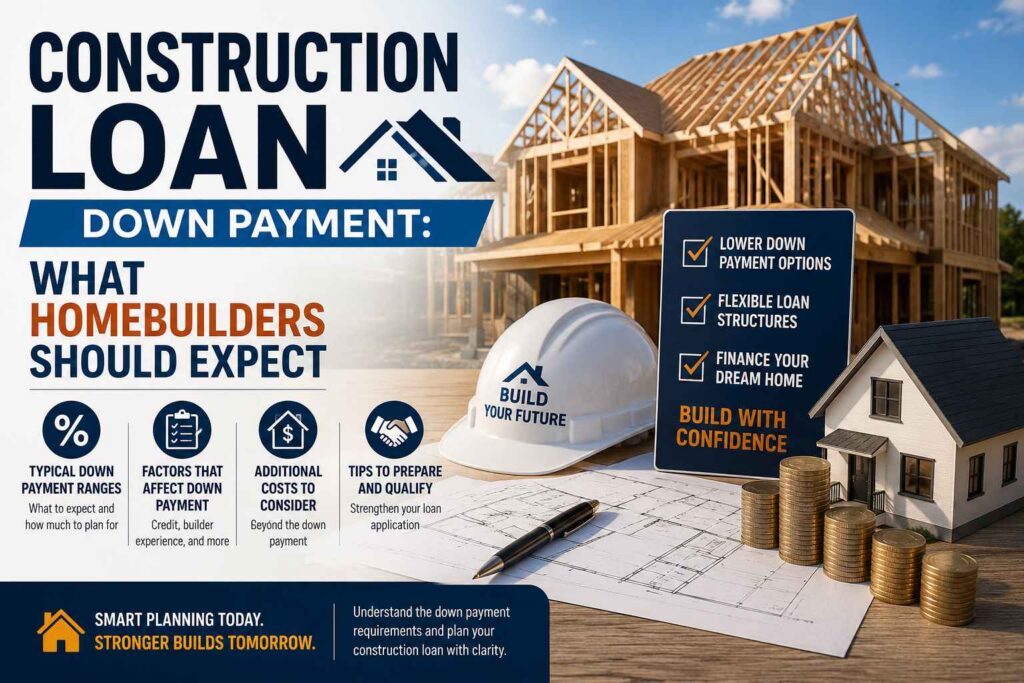
Building a home from the ground up is a dream for many, and understanding the financial side, especially the construction loan down payment, is a big part of making it happen. I’ve been looking into how these loans work, and there’s quite a bit to consider.
It’s not quite like getting a regular mortgage, and the down payment is just one piece of the puzzle. Let’s break down what you need to know about the construction loan down payment so you can get started on your building journey.
What is a Construction Loan Down Payment?
So, you’re considering building your own home? That’s awesome! However, before you begin selecting paint shades, let’s discuss the financial aspect. In particular, the down payment on a construction loan. It is a little different than purchasing an existing home.
In a nutshell, the down payment on a construction loan is the amount of cash that you put down initially to prove your commitment to the project to the lender. It’s your investment in the game. The quantity required may be quite variable. With some loans, such as some FHA loans, you may have as little as 3% down payment.
That’s pretty low! Lenders, however, typically require a greater investment, especially in the case of a custom home from the ground up, for a lot of traditional construction loans, 20% or higher. That’s because constructing a home is perceived as a greater risk than purchasing an existing home. To get a better idea, you can find out more about financing a custom home down payment.
Here is a brief overview of some factors that will determine how much you may require:
Loan Type: As I said, there are rules to different loan programs. Government loans (such as FHA) may have lower down payment requirements than conventional loans.
Lender Requirements: Each bank or credit union may have its own requirements for the percentage required for a construction loan, even for the same type of loan.
Your Financial Profile: Your credit score, income, and financial health may be a factor. A healthier financial situation may mean that the down payment requirement may be slightly lower.
Land You Already Own: If you already own the land on which you wish to construct, it may sometimes be part of your down payment. This won’t always be a simple replacement, though, we’ll get into that later.
One of the first steps is to know how much deposit for a construction loan you’ll need. It is not a fixed number, but depends on many factors. When you’re planning your budget, therefore, you should inquire lenders specifically about the amount of down payment for a construction loan they need for the type of construction you are planning.
This is an important component of determining the amount of your down payment for a construction loan. Keep in mind that this is just one of the many steps of the process and if you know the percentage amount required for a construction loan, you will save a lot of headaches down the road.
Construction Loan Down Payment Requirements by Loan Type
One of the first things that comes to mind when I’m thinking about buying a new home is the financial aspect, particularly the down payment. It’s not exactly the same as purchasing an existing home.
The down payment needed for a construction loan may truly differ with the kind of loan you end up with. It’s a little bit of a conundrum and I have discovered that it is important to understand these differences.
| Loan Type | Min. Down Payment | Credit Score Min. | Best For |
|---|---|---|---|
| VA One-Time Close ⭐ Best for Veterans | 0% | ~620 (lender varies) | Eligible veterans |
| USDA One-Time Close | 0% | 640+ | Rural area borrowers |
| FHA One-Time Close | 3.5% | 580+ | Lower credit buyers |
| FHA One-Time Close | 10% | 500–579 | Below 580 credit |
| Conventional OTC | 10–25% | 680+ | Strong credit buyers |
| Construction-Only | 20%+ | 680+ | Short-term builders |
Construction-to-Permanent Loans
These constructions to permanent loans are also referred to as “single-close” loans because they include both the construction loan and permanent mortgage in one. This way, you don’t have to go through the closing process twice, which can save you time and fees. With these types of loans, the down payment requirements may be comparable to those of a typical mortgage, but sometimes lenders will want a little more.
There have been requirements I’ve seen that require a minimum equity requirement for home construction loans, typically around 20% of the total project cost. But, some lenders may be more accommodating, particularly if you have a solid financial standing. It’s worth looking at the percentage down for new build mortgage options offered by your lender.
- Typical Down Payment: 20% or more, but may be less based on the lender and your qualifications.
- Builder Loan Upfront Costs: Beyond the down payment, be prepared for other initial costs, which might include appraisal fees, permits, and initial builder deposits.
- Flexibility: The down payment may be larger but the single closing makes the process easier.
It’s important to remember that the lender is taking on more risk with a construction loan since there’s no existing home as collateral. That’s why they have their construction loan requirements. They want to know that you have the financial resources to do the job. In some instances, your credit score, debt-to-income ratio, and financial situation will be examined closely by lenders when deciding the final requirements for the construction financing deposit.
I’ve also read that some lenders may be willing to allow you to use the equity in land you already own to pay some or all of the down payment, which is an interesting way of reducing your out of pocket expenses. This can be a significant help when trying to figure out what percentage down for new build mortgage is feasible for you.
FHA Construction Loan (One-Time Close)
I was a little confused when I began my search for home loans, as I was thinking of constructing my own house. One that continued to come up was the FHA construction loan, particularly the one-time close construction loan. It was a good deal, after all, who wants to go through the closing process twice, right?
What really caught my eye about the FHA construction loan is the down payment. If you are eligible, you can afford to make a 3.5% down payment. That’s a pretty sweet deal, particularly if you are like me and don’t have a ton of money saved up. It makes home building seem like a lot easier. If you’re interested, you’ll learn more about these low down payment options.
But it’s not all sunshine and roses. There are some requirements that you need to meet. Typically, if you have a credit score of 580 or above, then that 3.5% down payment is available. However, if your credit rating falls slightly, in the range of 500 to 579, you will probably have to pay 10%. That’s a factor to consider when making your budget. The bright side is, these loans are meant for individuals who may not be eligible for conventional loans, which is a great benefit.
Let’s take a quick look at the FHA one-time close construction loan:
- Low Down Payment: As low as 3.5% for those with a credit score of 580 or above.
- Single closing means that you do not have to go through the closing process twice, saving you time and hassle.
- Accessibility: This is for borrowers who may not be eligible for conventional loans.
- Credit Score Impact: If your credit score is below 580, you will likely need to make a 10% down payment.
It really makes the building process so much easier by having everything in one loan. You receive the money to construct, and then it becomes your long-term mortgage when the house is completed. There’s no need to fear interest rate fluctuations between two separate loans, which is a big relief.
If you’re thinking about construction and want to minimize the initial investment and loan process, this is a good choice. I’m still considering my choices, but this is definitely one that’s on my list.
VA Construction Loan (One-Time Close)
I am a veteran and when I first started considering building my own home, one of the options that I looked into was a VA construction loan. The one thing that really caught my eye was that it could be done with no down payment. When you’re trying to keep all of the costs associated with constructing a home from scratch, it’s a big deal.
The whole process is streamlined with a VA one-time close construction loan. Your construction loan and your permanent mortgage are combined into one loan. This will reduce the hassle and paperwork involved in the closing process since it is only done once. It also means that if you’re thinking that rates will rise, you’ll secure your permanent mortgage rate at the outset.
Here’s a little more on how it works:
- No Down Payment: For eligible veterans, VA loans, including those for construction, often don’t require a down payment. This is a significant benefit over numerous loans. For more information on VA loan benefits, check out their official resources.
- Single Closing: All the paperwork and closing costs are done once. This makes it a lot simpler than obtaining a separate construction loan and then a mortgage at a later date.
During construction, you will normally be paying interest only on the amount you’ve drawn from the loan, which is known as Interest-Only Payments During Construction. When you have your certificate of occupancy, the loan becomes your permanent mortgage.
Just keep in mind that the down payment may be nonexistent, but you will still need to qualify for a VA loan and the lender’s requirements. This typically requires a good credit rating and reasonable debt-to-income ratio.
A lender will also want to see detailed plans of your home, such as blueprints and a budget, as well as a contract from your builder. They want to be sure the project is well-planned and that you’re ready for the responsibility. Building a home is a big undertaking, but a VA construction loan can make it more achievable for those who have served.
USDA Construction Loan (One-Time Close)
I was just starting to look into building my own house and I heard about USDA construction loans, but I’m not sure they were that easy to understand. However, after a bit of research, I found that they can be a pretty great choice, particularly if you’re considering building in a rural area.
Key features:
- Zero down payment — for eligible borrowers in qualifying rural areas
- Single closing — construction and permanent mortgage combined into one transaction
- Income limits — USDA eligibility is subject to household income limits that vary by county
- Location requirements — property must be in a USDA-designated rural area
It was the “one-time close” that really grabbed my attention. It means that you take care of all the paperwork and closing costs only once, at the start. This is a huge deal as it makes the entire process much easier. Later on, you won’t have to deal with another loan application or a second set of closing costs, which can add up.
Conventional Construction Loans
Conventional construction loans — not backed by any government program — typically have the most stringent down payment requirements:
- 10–25% depending on the lender, borrower profile, and total project cost
- Higher credit score requirements — most conventional lenders want 680+ for construction loans
- More lender flexibility — on rates, terms, and builder approval requirements
The conventional one-time close construction loan combines construction and permanent financing similarly to government-backed options but without the program-specific eligibility requirements. This is the right path for higher-income borrowers who don’t qualify for VA or USDA programs.
Can You Use Land as a Down Payment for a Construction Loan?
I’m interested in putting my dream home together, and one of the big questions that I have been thinking about is the down payment. In particular, can I use the land I already own as part of the down payment? It seems like a no-brainer, right? I should have some say if I’m the one who owns the dirt. The good news is, in many instances, it can absolutely.
When Land Counts at Full Appraised Value
If you own the property free and clear (no mortgage), the lender may allow you to use the entire appraised value of the home to make your down payment. This is quite simple. They will have an appraisal done, and if that appraisal value comes in at, say, $100,000, then they will consider that your down payment. It’s similar to having cash on hand but it’s in the property. This is particularly true in the case of a one-time close construction loan, in which the land is included in the financing.
Our loan to buy land and build a house guide covers exactly how this combined financing structure works.
When Land Equity Is Restricted
But sometimes, it’s not that easy. Your land may have some equity, but perhaps not enough to pay the entire down payment requirement. Or, maybe you still have a little left on the land. In these situations, the lender might only allow you to use a portion of the land’s equity. They also may want you to pay off any land loan before they will accept its equity as part of your construction loan down payment.
It’s similar to a credit card limit, you can only use so much. Taking out a loan to free up land equity before you apply for the construction loan can also cause problems, as it may leave you with less money to put down when you apply for the construction loan.
When Land Cannot Be Used as Equity at All
And then there are times when using your land as a down payment just isn’t an option. This may occur when the land is not feasible for development, perhaps because it is in a floodplain or has other conditions that hinder development.
There may also be certain rules governing the type or location of the land by some lenders. It’s always best to talk to your lender early on to see if your land qualifies and how they’ll value it. It does not automatically count, you must get their permission first.
Real Math: How Land Equity Replaces Your Cash Down Payment
The following scenarios use the same baseline project. The only variable that changes is how long the borrower has owned the land and that single factor changes how much cash is needed at closing dramatically.
| ✓ Scenario 1 — Land Owned >12 Months | ⚠ Scenario 2 — Land Purchased 3 Months Ago | |||
|---|---|---|---|---|
| Financial Metric | FHA (3.5%) | Conventional (20%) | FHA (3.5%) | Conventional (20%) |
| Down Payment % Required | 3.5% | 20.0% | 3.5% | 20.0% |
| Lender Project Value Basis | $400,000 | $400,000 | $340,000 | $340,000 |
| Total Down Payment Due | $14,000 | $80,000 | $11,900 | $68,000 |
| Allowed Land Equity | $100,000 Full Appraisal |
$100,000 Full Appraisal |
$40,000 Lesser of Cost/Appraisal |
$40,000 Lesser of Cost/Appraisal |
| Remaining Equity Cushion | $86,000 | $20,000 | $28,100 | $0 |
| Out-of-Pocket Cash Needed | $0 ✓ | $0 ✓ | $0 ✓ | $28,000 ⚠ |
Baseline: Build cost $300,000 | Current land appraisal $100,000 | Total project value $400,000
Scenario 1 — Land Owned More Than 12 Months
Because the land has been held over a year, both FHA and conventional lenders credit the full $100,000 appraised value as equity.
FHA — 3.5% down: Required down payment on $400,000 = $14,000. Land equity of $100,000 covers it entirely. Remaining equity cushion: $86,000. Cash needed at closing: $0.
Conventional — 20% down: Required down payment on $400,000 = $80,000. Land equity of $100,000 covers it entirely. Remaining equity cushion: $20,000. Cash needed at closing: $0.
Scenario 2 — Land Purchased 3 Months Ago for $40,000 (Now Appraising at $100,000)
The “lesser of” rule kicks in. Lenders cap usable equity at $40,000, the original purchase price, and recalculate the project basis as build cost plus land cost ($300,000 + $40,000 = $340,000).
FHA — 3.5% down: Required down payment on $340,000 = $11,900. Land equity of $40,000 still covers it. Cash needed at closing: $0.
Conventional 20% down: Required down payment on $340,000 = $68,000. Land equity of $40,000 covers part of it, but leaves a $28,000 gap. Cash needed at closing: $28,000.
Using Land as Collateral for a Construction Loan
So, you’ve got some land, and you’re thinking about building. That’s great! Sometimes, the land you already own can be a big help when it comes to getting a construction loan. It’s not quite the same as handing over cash for a down payment, but it can definitely work in your favor.
Land as Collateral vs. Land as Down Payment — The Difference
When people refer to land as a down payment, they are typically referring to the amount of cash needed for the loan that is being paid with the land. It’s as if you were to say, ‘This land is worth X, and I’m paying that toward the total cost.
It’s a little different with land as collateral. Consider it to be a security for the loan. The lender considers your land and says, ‘If something goes wrong with the loan, this land is something that we can use to get our money back. It’s a method of getting the loan without having to deduct the entire amount of the loan from your initial down payment requirements, although it may help you satisfy those requirements as well. It’s a bit of a dual role it can play.
Cross-Collateralization Explained
This is where it can get a little more tricky, but it’s important to know. Cross-collateralization occurs when you take out several loans to cover one asset, such as your land. For instance, if you have a loan for the land and then you want to borrow against the land for your construction loan, you are cross-collateralizing.
Lenders may do this, but they’ll want to be very certain of the value and their position. Not always easy and some lenders may not accept this, or may have rules as to how much they will lend if this is the case. This is certainly a topic you should be talking about with your loan officer.
They will consider your credit score, income, and debts to ensure that you are able to afford the repayments and if you have some money left over when unexpected expenses arise during construction, it will be a great advantage. Being pre-approved can help you have a clear idea of your budget from the start.
In some cases, the land that you own can be utilized to pay off a portion or the entirety of your down payment for a construction loan. This is a typical method of financing the construction of a dream home. But the lender will determine the worth of the land, and it may not be used in full appraised value for the down payment. This can occur in a couple of situations:
If the land is free and clear (no loan on it) and the lender considers it to be in good condition and location, it may be accepted for your down payment at its full appraised value. This is the best-case scenario.
Land Purchase and Construction Loan — Can One Loan Cover Both?
You’ve located the ideal property to construct your dream home, but you haven’t yet purchased the land. Or perhaps you already have the land and are ready to begin building. The big question is: can you combine the land and construction costs into one loan? The great news is, you can often! This is also known as a “one-time close” construction loan and can make life a lot easier.
With a one-time close loan, the land purchase and the construction of the home are all included in a single loan. Only one application and closing process. This translates to reduced paperwork, lower fees, and a streamlined process. This is particularly useful when purchasing land and intending to construct immediately. You won’t need to worry about qualifying for a second loan later on if your finances change from the time you buy the land until you begin construction.
The general idea is that:
- Initial Application: You apply for a single loan that is used to finance the land acquisition and construction. As with any loan application, lenders will examine your credit, income and assets.
- Land Purchase: Once approved, the loan funds can be used to purchase the land. This could be a direct purchase or it could be the lender could do it as part of the loan.
- Construction Phase: Once the land is acquired, construction starts. Funds are generally paid out in stages or “draws” when various stages of the construction process are finished. Your lender will be the one to monitor this to ensure that all is well.
- Final closing: At the end of the construction there is a final closing. The loan then becomes your permanent mortgage. As it’s a one-time close, you don’t have to deal with the added closing costs and trouble that comes with refinancing.
If you have already spotted the ideal plot for your custom home, this type of financing can be a very practical method to build your home. It simplifies the entire process, making it less daunting. Certain loans, such as some USDA construction loans, are especially made to merge these steps. Having both land and building on a single loan can certainly help make your home-building journey easier.
Wrapping Up Your Construction Loan Journey
So, constructing a house is a major occasion, and the monetary part of it, particularly the down payment, can be like a puzzle. Whether you’re using a builder or working on your own, I’ve found that there are various methods to do it. Sometimes, you will have to pay an initial deposit and then pay another deposit later for the mortgage.
In other cases, such as with some government-sponsored loans, you may require less of a cash investment. It is certainly worthwhile to consult a loan officer early on to see what is best for you. The smoother the process, the more likely you’ll be to have all your paperwork in order and understand the lender’s needs. It may sound like a lot, but as long as you have a plan, you can be closer to that dream home.
Frequently Asked Questions
What exactly is a down payment for a construction loan?
Think of a down payment for a construction loan as your initial investment to show the lender you’re serious about building. It’s a portion of the total building cost that you pay upfront. This helps the lender feel more secure about lending you the rest of the money needed to build your home.
How much money do I usually need for a down payment on a construction loan?
The amount can vary a lot! For some loans, especially government-backed ones like FHA or VA, you might be able to get started with a very small down payment, sometimes even 0%. However, for many traditional construction loans, lenders often want to see around 10% to 20% of the total project cost upfront. It really depends on the specific loan type and the lender.
Can I use land I already own as a down payment?
Yes, in many situations, the land you already own can count towards your down payment. The lender will look at the value of your land, usually based on an appraisal. Sometimes, they’ll accept its full value, but other times they might limit how much equity from the land they’ll count. It’s definitely something worth discussing with your lender. Understanding how a construction loan works when you own land is essential reading before your lender conversation.
What’s the difference between a construction-only loan and a construction-to-permanent loan regarding down payments?
With a construction-only loan, you get a loan just for the building phase, and then you need a separate mortgage later. This might mean paying a down payment for the construction loan and then another one for the mortgage. A construction-to-permanent loan, on the other hand, combines both into one loan, often requiring just one down payment at the beginning. This can simplify things and potentially save you money on fees.
Can first-time home buyers get a construction loan?
Absolutely! Being a first-time home buyer doesn’t automatically disqualify you. As long as you meet the lender’s requirements, which usually include having a good credit score, a steady income, and being able to cover the down payment, you can definitely get a construction loan to build your dream home. Veterans buying for the first time should review our first-time VA home buyer guide for a complete walkthrough of the process and the single close construction loan guide covers first-time builder considerations in detail.
What happens if my construction project goes over budget?
If the building costs more than you initially planned, you’ll likely need to cover those extra expenses. You might have to pay them out of your own savings, or you could ask your lender if it’s possible to modify your loan. Any changes or extra costs are usually subject to the lender’s approval, so it’s always best to have a bit of extra money saved up just in case.