

Thinking about a new home but feeling overwhelmed by the prices of traditional houses? You’re not alone. Many people are looking at factory-built options like modular and manufactured homes to get into homeownership. While they both start in a factory, they’re actually quite different.
Let’s break down the modular home vs manufactured home debate, looking at what you get for your money, how they’re built, and which might be the better fit for you.
Understanding the Basics: What’s the Difference?
When you start looking into homes built off-site, you’ll run into a few terms that can sound pretty similar: modular homes and manufactured homes. They get confused quite easily, but there are significant differences that should be clearly understood, particularly relating to building regulations, their configuration, and also how lenders and the market will perceive them. To make the right decision for you, it is crucial to grasp these mobile home vs modular home comparisons.
Modular Homes: Built to Code, Built for You
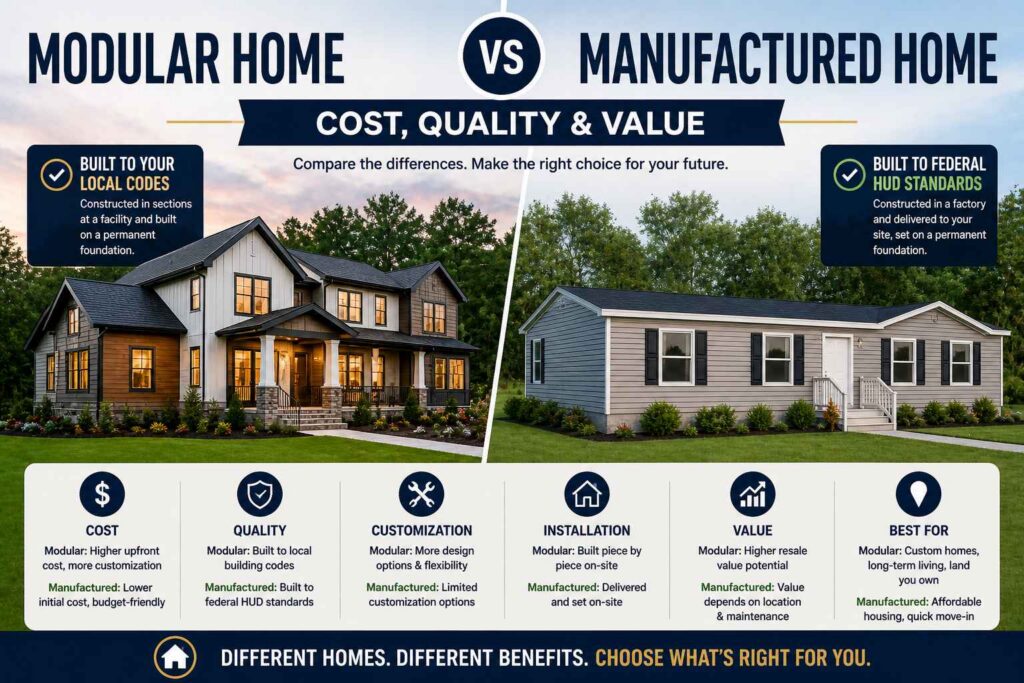
Modular homes are factory-built in sections, similar to how a puzzle is assembled. Once those sections are done, they’re brought to your site and assembled on a permanent foundation. Consider them as houses constructed to the same specifications as a conventional house you could round up outside of its lot.
The key difference here is that modular homes must adhere to virtually all local and state building codes applicable to site-built homes in your area. What that means is that the codes can differ based on your location when building. Since they are manufactured to these particular codes and set on permanent foundations, generally speaking, they increase in value over time like a traditional home.
- Follows local and state building codes.
- Assembled on a permanent foundation.
- Can be customized extensively.
Manufactured Homes: Factory-Built, Site-Delivered
Something like manufactured homes, which many generations ago used to be what people called trailer homes (but that were old-style mobile homes built predating 1976), are also factory-built. However, they are constructed to a federal standard known as the HUD Code. This follows a common code throughout the country. They are constructed on a permanent, strong steel chassis so that they can be moved to your site.
Though they have the option to be placed on a permanent foundation, they can also be easily transported down the line, although this is typically not that easy. Due to the HUD code and how they are constructed, they can both be financed differently than modular homes and appreciate in a different manner.
Unlike modular homes, which must meet local and state codes, manufactured homes are built to a national standard (HUD Code). This is a primary distinction.
- Built to the federal HUD Code.
- Constructed on a permanent steel frame.
- Can be placed on leased or owned land.
- Often more affordable upfront compared to modular homes.
This distinction affects how they’re classified for financing purposes, manufactured homes may qualify for manufactured home loan programs rather than standard mortgages in some cases.
Cost Comparison: Which Offers Better Value?
Talking about the cost of homes is not just in terms of the sticker price, right? So, there’s so much more to find, especially if it is a modular or manufactured home. However, these off-site homes often have a distinct financial situation from on-site built houses.
Initial Purchase Price: Modular vs. Manufactured
On average, manufactured houses are much more cost-effective than modular homes. Manufactured homes are permanently affixed to a chassis (vehicle-type frame), the purpose of which is to circumscribe overall maximum design standards as set by federal HUD law. This can mean big savings to the buyer. Factory-built homes typically run about $85 per square foot.
Though still an affordable alternative to on-site built homes, modular houses typically have a higher price than manufactured dwellings. This is, in part, because they come equipped with the local building codes typical for traditional homes and are set atop a permanent foundation. The ability for greater customization and compliance with stricter local codes can inflate first costs. But it also means that lenders and appraisers often evaluate them more fairly as real estate.
Here’s a quick look at the general price differences:
| Home Type | Average Cost per Sq Ft | Notes |
|---|---|---|
| Manufactured | ~$85 | Lower upfront cost, built to HUD code, permanent chassis. |
| Modular | Higher than manufactured | Built to local codes, permanent foundation, and more customization. |
For a broader perspective on what different construction approaches cost, the cost to build a custom home and house to build per square foot guides provide useful benchmarks.
Long-Term Costs: Maintenance, Energy Efficiency, and Resale Value
So, thinking long-term is essential. Where this housing type begins to really change its value proposition from the passive, single-family detached home.
Energy Efficiency: both types of manufactured homes must be very energy efficient, generally even more than older homes built on a site (which was not the situation 40 a long time ago years ago) because high-quality construction may arise in any kind of factory environment and tighter building qualities. Features may vary, and there are different levels of insulation, so be sure to ask how the windows will be rated for energy efficiency as well.
Maintenance: Modular homes are built to local codes and set on permanent foundations, so they usually need the same types of maintenance as conventional homes. Because of their construction and chassis made to withstand the heat, manufactured homes can last through high winds, but they may require more maintenance.
Resell value: This is a huge one. According to industry experts, modular homes appreciate over time since they are built the same way a site-built home is and follow local codes. They are also usually more appealing to a wider pool of buyers because they qualify for traditional mortgage financing. Manufactured homes, with certain caveats, are a little more complicated. If they could never leave the plot of land you own, sure, they can appreciate, but they can also depreciate just like a car. Manufactured home financing can also use chattel loans, which differ from standard mortgages as far as terms and interest rates.
Although the initial price for a mobile home vs. a modular home cost is just one factor to keep in mind, long-term costs, how you plan to finance it, and possible appreciation are key to the value of your home. With many financing options out there and varying qualifications between the two, it may be a beneficial early step to consider financing.
In short, while innumerable articles listing the benefits and drawbacks of either kind exist, knowing the specifics will empower you to pick between them in ways that suit your needs and visions. Comparing Off-Site Built Homes: Where Manufactured Homes Win on Price, Modular Homes Often Win in Long-Term Value and Appreciation.
Quality and Construction: A Deeper Dive
We know that when it comes to building a house, quality and the assembly of it really do count. This is not just about the surface, but how robust it is going to be within and how long it will last.
The difference between modular and manufactured homes begins with the way each is built, and comprehending this process is crucial to determining which one is right for you. They’re not just insignificant facts; they touch on durability, what sort of home you’ll be living in, and how safe that residence will be.
Building Standards and Regulations
Modular and manufactured homes are both constructed to federally approved specs, but they’re pretty different. Some people are under the impression that just because they’re constructed off-site, they might not be built to the same standards as a house that is built directly on your land. Unfortunately, not usually.
Modular Homes: These homes, like traditional site-built homes, are constructed on-site to the same local and state building codes. On the other hand, when you see it this way, a factory is just a different workshop. The construction is frequently executed by third-party inspectors during different phases to ensure everything remains up to par. This means that your modular home is built to all of the exact same safety and structural requirements as a site-built house constructed from individual pieces on your property.
Manufactured Homes: Because they follow a national standard known as the HUD Code. The U.S. Department of Housing and Urban Development sets this code, which includes everything from fire safety to structural integrity to energy efficiency. It’s a one-size-fits-all nationwide standard regardless of where the home ultimately goes.
You must notice that both are regulated differently. At the end of this article, we will explain the difference in oversight.
Materials and Customization Options
The mediums they were made of and how much input they have in what it looks like are questions that people want to know about. Because both of these homes are constructed in a factory, there’s an intriguing advantage to consider.
Materials get protected from weather damage and, because construction happens indoors, the build can be longer lasting and of a higher quality. This led to a more controlled environment, the crew able to work in better circumstances, which frequently results in higher accuracy of manufacture.
As you see, in general, when it comes to customization:
Modular Homes: More often than not, you are very flexible. You will often select from different floor plans, finishes, and upgrades. Building codes for factory-built homes are the same as those for site-built homes, allowing some of the most customization available without going through a traditional home construction process.
Manufactured Homes: Some customization is available, but possibly not as much as with modular homes. This gives you some choices from manufacturers, which means calling it a home of your own, but the basic framework and shape may not be as varied as a modular or site-built home.
Here’s a quick look at how the building process impacts quality:
| Feature | Modular Home | Manufactured Home |
|---|---|---|
| Building Standard | Local/State Codes (IRC, NEC) | National HUD Code |
| Inspection | State & third-party inspectors | HUD & third-party agencies |
| Environment | Controlled factory setting | Controlled factory setting |
| Material Protection | Protected from weather | Protected from weather |
| Customization | High flexibility | Moderate flexibility |
Because modular and manufactured homes are made in a factory, with controlled conditions (that keep materials dry and straight) and workers who have the proper tools to use on an assembly line. This allows for potentially greater accuracy, uniformity, and consistency in the build versus traditional construction, where materials are subject to the elements during the building time frame.
The Value Proposition: Which is Right for You?
So, you’ve looked at the differences in how these homes are built and what they cost. Now, let’s talk about which one might actually be a better fit for your life and your wallet in the long run. It’s not just about the sticker price, you know?
Pros and Cons at a Glance
When you’re trying to decide, it helps to see it all laid out. Think of it like packing for a trip – you want to know what’s coming with you and what you’re leaving behind.
Modular Homes
- Pros:
- Generally appreciate in value more like traditional homes, especially when built on a permanent foundation and on desirable land.
- Offer a lot more flexibility in design and customization. You can really make it your own.
- Fewer zoning issues in many areas, making placement easier.
- Often qualify for traditional mortgage financing, which can be simpler.
- Cons:
- Higher upfront cost compared to manufactured homes.
- Construction can take a bit longer due to site prep and final assembly.
Manufactured Homes
- Pros:
- Significantly more affordable upfront, making homeownership accessible to more people.
- Built quickly in a controlled factory environment, reducing weather delays.
- Can be a great option if you need a fast housing solution.
- Some models are eligible for specific financing programs that can help with down payments, like VA loans for veterans.
- Cons:
- Typically don’t appreciate in value as much as modular or site-built homes, as they aren’t usually permanently attached to land.
- Customization options are more limited compared to modular.
- May face zoning restrictions in certain communities.
- Financing can sometimes be more complex, though options are improving.
Which choice is ‘better’ truly depends on what you individually care about more. Modular homes are probably a good choice if the long-term value and exercise in design freedom top your wish list and your budget permits. If your focus is on affordability and speed of construction, a manufactured home may be just what the doctor ordered for you.
Finding a home is an endeavor, and it comes down to what works for you. And keep your budget, timeframe, and the way your home should work for you over the years in mind. Modular homes and manufactured homes are both means to homeownership, but in different ways.
Making Your Decision
You have researched modular and manufactured homes; now it’s time to determine which one would make the most sense for you. The realness of how it really comes down to what do you matter more. If economy is your primary concern and you’re okay with fewer customization options, a manufactured home may be the route for you. They are built to a national HUD code, which is an excellent standard, and they can be an awesome way to get into home ownership without bankrupting yourself on a mortgage.
In contrast, however, modular houses are constructed just like traditional site-built houses that meet local building codes. This means they tend to be a little bit more forgiving with the design, and sometimes easier to tailor to your exact preferences. They are usually constructed on a permanent foundation, which affects their resale value and marketability to lenders. Think of it this way:
You can use manufactured homes when it comes to purchasing more affordable housing options, and they tend to be designed for the HUD code property with little customization, but usually appreciate that much.
Modular Homes: designed to meet local codes, greater potential for customisation, usually permanent foundations, and often possible with better appreciation.
When deciding between the two, keep in mind that both are manufactured at a factory to strict standards. Not only does this typically cut waste, but it also reduces weather delays and provides more consistent quality control when constructing on-site. That is how to build a home, but it’s smart.
At the end of the day, it comes down to your budget, how customized you want things, and what your long-term goals are for the property. Another thing to keep in mind, for veterans, is how VA loans work for those homes, as the process varies somewhat from your traditional home loan.
A smart first step is to get pre-approved and speak with lenders familiar with manufactured and modular financing. With many different types of mortgages available – especially backed by the VA you want to make sure you understand all the criteria & guidelines with your purchase.
So, Which Home is Right for You?
Alright, so we’ve gone over modular and manufactured homes, and it’s clear neither is a one-size-fits-all answer. If you’re really watching your wallet upfront and need to get into a home quickly, a manufactured home might be your best bet. They’re generally cheaper and can be a great way to start building equity. But keep in mind, they might not appreciate as much over time, and financing can sometimes be a bit trickier.
On the other hand, modular homes usually cost more to start, but they’re built to local codes, sit on permanent foundations, and often feel more like a traditional house. This means they tend to hold their value better and are easier to finance with standard mortgages. Ultimately, the choice really boils down to what you can afford right now, what your long-term plans are, and what’s even allowed in the area where you want to build. It’s worth talking to a home consultant or a lender to figure out the specifics for your situation.
Frequently Asked Questions
What’s the main difference between a modular home and a manufactured home?
Think of it like this: modular homes follow the same strict building rules as regular houses built on-site, but they’re put together in a factory. Manufactured homes are also built in factories, but they follow federal rules (called HUD code) and are built on a metal frame, which means they can be moved, though they aren’t meant for constant moving. Modular homes are usually put on a permanent foundation, making them feel more like a traditional house.
Are modular homes more expensive than manufactured homes?
Generally, yes. Modular homes often cost more upfront because they’re built to local codes, which can be more detailed, and they’re designed for permanent foundations. Manufactured homes usually have a lower starting price, making them a more budget-friendly choice for many people.
Which type of home is better for long-term value?
Modular homes tend to hold their value better over time and can even increase in price, much like traditional homes. This is because they’re built to local codes and placed on permanent foundations. Manufactured homes might lose value over time, especially if they aren’t on land you own or if they aren’t well-maintained.
Can I get a regular mortgage for a modular or manufactured home?
It’s usually easier to get a standard mortgage for a modular home because lenders treat them similarly to site-built homes. For manufactured homes, it can sometimes be trickier. If the home is permanently attached to land you own, you might qualify for a regular mortgage. Otherwise, you might need a special loan called a chattel loan, which can have higher interest rates.
Which type of home offers more choices for design and features?
Modular homes generally offer more options for customization. Because they’re built to local codes and are meant to be permanent, builders can often adapt the floor plans and finishes more easily to your specific needs and style. Manufactured homes also have customization options, but they might be more limited compared to modular homes.
Are manufactured homes still considered ‘mobile homes’?
The term ‘mobile home’ usually refers to older homes built before 1976. Today’s manufactured homes are built to stricter federal standards (HUD code) and are much more durable and better built. While they are built on a metal frame that allows them to be transported, they are designed to stay in one place once set up, unlike the older, lighter mobile homes.