
Buying a home is a big deal, right? For Veterans, the VA loan program can make it a lot easier. But if you’re a disabled Veteran, you might be wondering if things are different for you. The good news is, being a disabled Veteran often means you get even more benefits.
This article is all about the VA loan for disabled veterans, breaking down what makes it special and how you can use it to get into a home.
Understanding the VA Loan Program
The VA home loan program is an incredible benefit for our nation’s veterans. In reality, it’s not a loan from the Department of Veterans Affairs directly but rather a private lender that provides these types of guaranteed-funding loans.
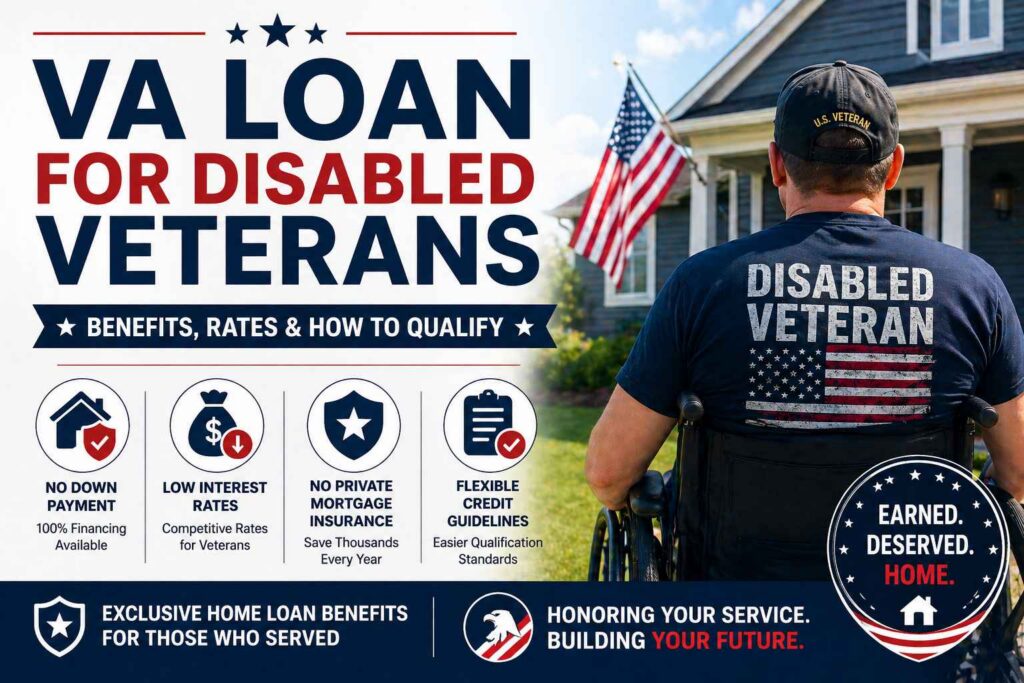
All of which leads to what amounts to a guarantee that enables lenders not only to offer veterans some rather terrific deals, but also with no need for a down payment and no private mortgage insurance (PMI). It’s a one-time benefit that can be used repeatedly if you qualify.
Consider it a government hand in helping you realize property ownership that would otherwise be difficult to achieve. The VA guarantees some of the loan, so lenders can stretch a little on terms. You can use this program for a wide range of things:
- Buying a new home
- Building a home from the ground up
- Repairing an existing home
- Making a home suitable for a disability
- Refinancing an existing VA loan to get a better rate
It’s also quite a general-purpose tool for veterans. The overriding aim is to ease you into settling down and having an abode that you can truly call your own. VA home loans may be the best entry point into the housing market and, in many cases, feature keywords for which a programmed loan would struggle to compete.
Created to help veterans and service members achieve homeownership, the VA loan program. Lenders are insured against losses because the VA provides a guarantee, which is good news for borrowers in terms of loan terms. This is not just a benefit; this is something that speaks to the dedication this country has for those who have served.
What Makes the VA Loan Unique for Disabled Veterans?
Thus, you are a disabled Veteran considering a VA loan. That’s great! The VA loan program is good already, but if you have a service-connected disability, there are additional benefits that may seriously help. This does not simply mean getting a mortgage; it means obtaining a mortgage with some major benefits.
The VA Funding Fee Waiver
For many disabled Veterans, this is likely their largest signature. You know that VA funding fee. This is a single fee that covers most VA loans. It props up the program and subsidizes other borrowers. The bad news is that if you’re a military retiree, this will cost you; however, if you collect VA disability compensation, you’ll usually be off the hook for this fee.
Here is what you need to keep in mind: this fee could be several thousand dollars based on the size of your loan and down payment. That fee could be more than $5,000 for a loan of $250,000. That means no upfront cost, or not having to roll that into your loan. That means immediately, more money in your pocket.
It’s estimated that approximately one out of three Veterans who would normally be eligible for a VA loan won’t have to pay this fee. You are probably in there if you have a rating of 10% or more for service-connected disability. However, you can’t get a refund of the fee even if you are given your rating post-closure.
Use the VA funding fee calculator to see exactly how much you’d save based on your loan amount and service history.
Additional Benefits for Disabled Veterans
The VA loan program also has features designed to help disabled Veterans, aside from waiving the funding fee. To begin with, Lenders will usually look at your disability income more favorably. It is stable and reliable, precisely what lenders like to see.
This implies that disability compensation can be included in your income when qualifying for a loan. This non-taxable income can even be ‘grossed up’ with some lenders, meaning the amount you can borrow may be more than that of those who pay tax. This is a good way to build your purchasing power.
Look out for property tax exemptions, which vary by state. Many states provide these to disabled Veterans, and the savings can be substantial over time. The regulations are different, so it is worth checking out what your state has to offer.
In fact, veterans rated 100% disabled may have additional housing benefits; in some cases, incorporating grants for specially adapted housing. These grants can be used to make a home more accessible, such as adding ramps or grab bars. Either way, it’s all about helping you be more independent.
- VA Funding Fee Exemption: Most disabled Veterans receiving compensation are exempt. This can save you thousands of dollars.7
- Disability Income Counts: Your VA disability compensation can be used as qualifying income for the loan.
- Potential Tax Breaks: Look into state property tax exemptions for disabled Veterans.
- Housing Grants: Programs like SAH and SHA can help adapt homes for specific needs.
The VA may also appoint a fiduciary if, at times, a Veteran is rated as incompetent to manage his or her own finances. If that describes you, you can still qualify for a VA loan, but such cases require prior approval from the VA. They rely on data available till Oct 2023, just to double-check whether the loan you sought is actually good for you or not, and this extends a little time to the process.
Receiving a VA loan is a monumental step, but these additional perks can help ease the process and bring things into perspective. You should discuss these nuances with a VA-approved lender.
They can assist you in determining the specific relevance of these advantages to your situation and walk you through what it takes to get pre-approved. Keep in mind, if you’re purchasing with a spouse or any eligible co-borrower, they can also combine incomes through a joint VA loan, although non-veteran borrowers may be required to put down some money.
Eligibility Requirements for Disabled Veterans
Now you might have asked, so are a disabled Veteran, can I get a VA loan? The good news: Yes, you can. If you’re a Veteran, the VA loan program assists you in becoming a homeowner, and being disabled does not disqualify you from being eligible. So, there are a few key things the VA and lenders will look at to make sure you:
Service Requirements
Well, let’s be honest up front, just like any other Veteran trying to use a VA loan benefit, you have some requirements. This is essentially how the VA validates your service to our country. Details vary a little depending on when your service was, but generally it is an x number of days active-duty service or certain time periods for service during war/peacetime.
- Wartime Service: Typically requires at least 90 consecutive days of active duty.
- Peacetime Service: Usually requires at least 181 days of continuous active duty.
- National Guard/Reserves: Specific requirements apply, often involving at least six years of service.
It’s always a good idea to check the most current VA guidelines or talk to a VA loan specialist to confirm your specific service meets the criteria.
Disability Status Verification
This is where it gets a little more specific to disabled Veterans. Some VA benefits to which you are entitled do require that you have your disability status verified, such as the waiver of the VA Funding Fee. Most times, your official VA disability rating reflects this.
- Service-Connected Disability: You need to have a disability that the VA considers is related to your time in service.
- Disability rating: No matter what, obtaining a service-connected disability rating can serve as an added boon for veterans; however, the actual advantages tend to come most heavily into play with the funding fee waiver at 10% or higher.
The VA will require evidence of your disability rating. Usually, this is a letter from the VA stating your disability percentage and that it is service-connected. If you are not certain of your rating or need paper documentation, this info is often obtainable via your VA.gov account or by calling the VA. That verification is used to qualify for certain housing assistance for disabled veterans and other benefits.
As with any other loan, lenders will consider your overall financial profile, such as your credit score and debt-to-income ratio, etc. Your VA disability compensation, however, can be assessed as steady revenue; now that is certainly a plus! It’s free of taxes, and lenders may be able to ‘gross up’ this income (meaning count more of it in your qualifying income), which could let you borrow even more. It has made it easier for years to get into suspension for disabled Veterans.
How to Apply for a VA Loan as a Disabled Veteran
First, you are a disabled Veteran and asking yourself How to get a home loan with VA disability benefits. It is not as difficult as we think. Now, let us decode it. The VA loan program was and still is meant to help folks just like you buy their home, with a little bit of extra down payment guidance. Consider this: you’re a veteran who has done your time, and it’s now the VA’s turn to assist you with one of the largest transactions you’ll make.
Obtaining Your Certificate of Eligibility (COE)
First things first, you need your Certificate of Eligibility or COE. Basically, this little document here is your VA golden ticket that establishes you have met the basic service and discharge requirements to qualify for the loan. It also indicates that you’re qualified for the VA home loan perk.
This is available online through the VA’s benefits portal, and it can usually be obtained by your lender as well. This part is simple enough, but having it in place helps everything else go much quicker.
Finding a VA-Approved Lender
The next step is to find a lender that actually does VA loans. And not every single bank or mortgage company does. You want to seek lenders who specialize in VA loans, and even more so for the disabled Veteran.

They will be able to walk you through the basics of VA home loan eligibility for disabled vets and details about any special VA loan programs for disabled veterans that may pertain to you. Shop around and compare offers; do not be afraid to take your time.
Here’s a general idea of what lenders will look at:
- Credit Score: While the VA doesn’t set a minimum, most lenders prefer a score of 620 or higher. If yours is a bit lower, don’t despair; some lenders look at other factors.
- Income and Employment: They’ll want to see a stable income. Good news: your VA disability compensation can often be counted as income, which is a big plus.
- Debt-to-Income Ratio (DTI): This is how much of your monthly income goes towards debt payments. Lenders like to see this ratio kept at a reasonable level.
Keep in mind that it is your disability rating itself that does not disqualify you. In fact, it has some pretty benefits attached to it, such as no VA Funding Fee. It demonstrates that you can afford the monthly payments every month.
After you have your COE and chosen a lender, they will take you through the remainder of the application process, such as an appraisal of the home and a closing date. It is a process, for sure, but very doable.
VA Loan Interest Rates for Disabled Veterans
Interest Rates for VA Mortgage for Veterans with Disabilities: What to Know. You may be wondering how hard it is to get approved for a VA loan, and we have good news: the VA loan program was specifically designed so that veterans can utilize it. The VA does not establish interest rates, but since they guarantee the loans, this means that lenders can offer competitive interest rates.
These rates can be lower than conventional loans for disabled veterans. One reason for this is that a VA loan is a lower-risk product for lenders with a government guarantee. And, as a bonus, disability income is often tax-free.
This is great if you need to put more of this type of income towards qualifying, because lenders can “gross up” this income, making it count as even more than its face value when figuring out what you’re qualified for, helping you qualify for a larger loan and/or better terms.
Here’s a quick look at what influences your rate:
- Your Credit Score: A stronger score generally earns a lower rate. Review minimum credit score requirements before applying.
- Your Debt-to-Income Ratio: Lenders look at how much you owe compared to how much you earn.
- Market Conditions: General economic factors play a big role in interest rates across the board.
- Loan Type: Whether it’s a purchase, refinance, or specific grant-related loan can affect the rate.
Note that the VA Funding Fee, although waived for most disabled veterans, is not included in the interest rate but is a separate benefit entirely. That said, going without that fee can mean saving thousands in upfront costs, which makes the upfront part of financing homes, knowing that the VA Loan is for disabled veterans.
VA mortgages for service-related disabilities. Just remember: compare offers from multiple lenders when shopping for a VA mortgage. A small difference in Interest rate can save you considerable sums over the lifetime of your loan. Feel free to approach lenders and inquire how your status as a person with disabilities may affect their rates and terms.
Although there is no such thing as a ‘disabled veteran interest rate’ from the VA disabled veterans will qualify for financial assistance through other programs – the combination of the VA guarantee on loans, a lean toward lower rates and the waiver of the funding fee make the VA loan an excellent choice for home financing in general as just about all disabled veterans typically wind up more than qualified by comparison. Always obtain quotes and speak to several VA-approved lenders about your individual circumstances.
Wrapping Up Your VA Home Loan Journey
So, as you can see, being a disabled Veteran doesn’t mean you’re out of luck when it comes to buying a home. In fact, your service and any related disabilities can open doors to some pretty great benefits. We’ve talked about how your disability pay can count as income, how you might get out of paying that VA funding fee, and even grants that can help make your home more accessible.
Plus, there are potential tax breaks out there, too. It might seem like a lot to sort through, but remember, the VA loan program is there to help you. Don’t hesitate to reach out to a VA loan specialist to figure out exactly what works for your situation. Getting into a home you love is definitely within reach.
Frequently Asked Questions
Can disabled Veterans use their disability money to help qualify for a VA loan?
Yes, absolutely! Lenders often see your disability compensation as a steady and reliable income, which can really help you qualify for a VA loan. It’s like having a consistent paycheck that counts towards your ability to pay back the loan.
Do disabled Veterans have to pay the VA Funding Fee?
Great news! If you receive VA disability compensation for a service-related injury, you’re usually exempt from paying the VA Funding Fee. This fee is normally a percentage of your loan amount, so skipping it can save you thousands of dollars. Use the VA funding fee calculator to confirm your exemption status and see the dollar savings on your specific loan amount.
Are there special grants for disabled Veterans who want to buy or adapt a home?
Yes, there are! The VA offers grants like the Specially Adapted Housing (SAH) grant. These grants can help you buy, build, or change your home to make it easier to live in, especially if you have a service-connected disability. Think ramps, wider doorways, or grab bars – these grants can help cover those costs.
Can a disability rating affect my ability to get a VA loan?
Not at all! Having a disability rating doesn’t hurt your chances of getting a VA loan. In fact, it often comes with extra benefits, like the funding fee waiver and the ability to use your disability income. Your credit and income are still important, but your rating itself is usually a plus.
What are property tax exemptions for disabled Veterans?
Many states offer property tax breaks for disabled Veterans. Depending on your disability rating and where you live, you might pay less in property taxes or even none at all. This can be a significant saving each year, and it’s worth looking into your state’s specific rules.
What if a Veteran is rated incompetent by the VA?
If the VA decides a Veteran can’t manage their own benefits due to health reasons, they’ll appoint a trusted person called a fiduciary. While these situations need extra review from the VA to make sure the loan is in the Veteran’s best interest, it’s still possible to get a VA loan.