

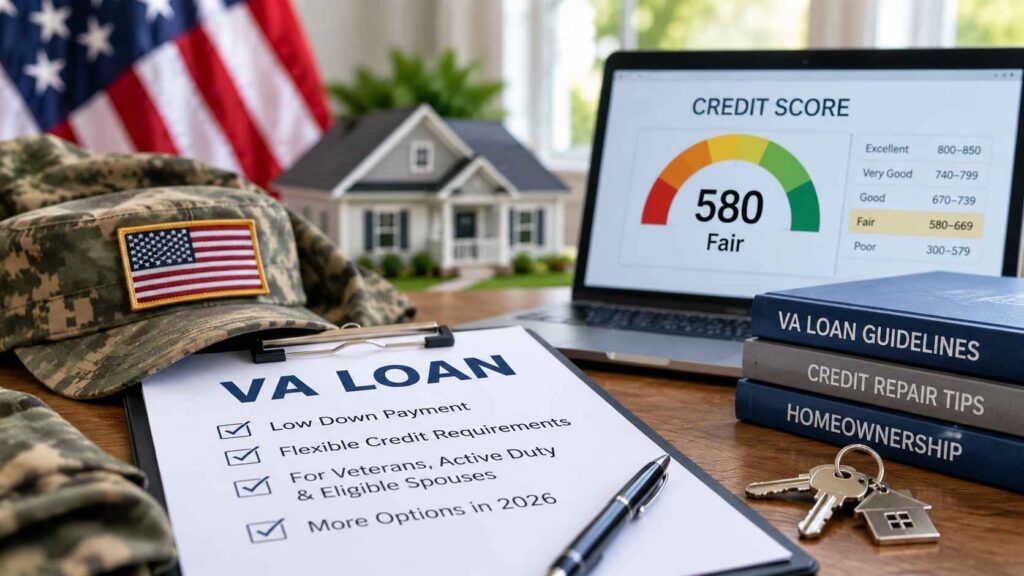
A low credit score does not automatically eliminate your VA home loan benefit, because the Department of Veterans Affairs does not publish one universal minimum credit score for VA-backed purchase loans. That flexibility does not mean credit is optional: the VA Lender’s Handbook says a poor credit history can be a reason to disapprove a loan, and private lenders can set their own minimum scores and underwriting overlays.
For a borrower with bad credit, approval usually depends on the full pattern behind the score, including recent payment history, debt, residual income, employment, assets, collections, judgments, and any major events such as bankruptcy or foreclosure. This guide explains the current 2026 rules in the order a borrower actually needs them, from credit-score expectations and collections to pre-approval, credit rebuilding, and realistic options when approval is not available yet.
Key Takeaways
- A score of 640 or above is a preferred profile for VA construction inquiries, not a universal approval cutoff; the applicable lender’s requirements govern.
- Lenders review payment history, debt, income, assets, and remaining monthly income.
- Checking reports and correcting errors can strengthen a loan application.
- Lowering debt and making every payment on time are among the most useful steps.
- If approval is not realistic yet, other loan programs or a later application may make sense.
Understanding VA Loans and Credit Requirements
A VA loan is backed in part by the Department of Veterans Affairs and made through a private lender. That structure can offer eligible borrowers favorable financing terms, but it does not remove the lender’s responsibility to assess repayment risk. Credit is one part of that review, not the entire decision.
What is a VA Loan?
A VA loan is a home loan benefit for eligible Veterans, Servicemembers, and some surviving spouses. The VA guarantees a portion of the loan, which can help a private lender offer terms that may include no down payment and no private mortgage insurance for qualified borrowers. Eligibility, occupancy, income, and property requirements still apply.
The benefit is not a promise that every application will be approved. A lender underwrites the borrower, the property, and the loan together. Before applying, it can help to review a guide to the VA Home Loan Guarantee, including how the Certificate of Eligibility and entitlement fit into the process.
The Role of Credit Scores in VA Loans
Credit scores help lenders estimate how consistently someone has managed borrowed money. A lower score can lead to closer review, additional conditions, or a denial, while a stronger recent payment history may help put older problems in context. The score itself is only a snapshot; the information behind it matters too.
For someone considering a VA Loan With Bad Credit, the goal is not simply to chase a particular number. It is to understand what a lender will see, explain serious past events honestly, and show that current finances are becoming more dependable. Recent financial stability matters because underwriters often weigh the pattern of repayment alongside the score.
Can You Get a VA Loan With Bad Credit?

Approval depends on the applicable lender’s current guidelines and the complete borrower, builder and project file. In our experience, VA one-time close construction approvals below 640 are less common and may require a stronger overall financial profile. A lower score is not an automatic denial, and meeting 640 does not guarantee approval. You may request an individual review of available options. Credit improvement also varies by person; no specific point increase or completion date is guaranteed.
The phrase “bad credit” also covers several different situations. A thin credit file, high balances, missed payments, collections, bankruptcy, or a foreclosure can each affect an application differently. That is why a conversation with a lender should focus on the complete history rather than a single three-digit number.
VA Loan Credit Score Minimums: What Lenders Look For
Security America Mortgage follows the requirements of the lender and program used for each loan. Our preferred credit profile for VA one-time close construction inquiries is 640 or above. Borrowers below that level may still request a review; a loan professional must consider current program requirements and the complete file before determining whether an option is available.
There is no single VA-mandated score that applies to every lender. In practice, lenders commonly establish their own minimums, and those thresholds can vary by loan type, borrower profile, and current underwriting policy. A lender may also set additional requirements beyond the baseline VA guidelines.
When comparing lenders, ask directly about their current minimum score, whether they consider compensating factors, and what documentation they need for older credit events. This simple comparison can prevent wasted applications and make the process more transparent.
| Credit Factor | Why a Lender May Review It | What a Borrower Can Do |
|---|---|---|
| Payment history | Shows whether obligations were paid as agreed | Bring accounts current and avoid new late payments |
| Credit utilization | Indicates how much available revolving credit is being used | Pay down balances where practical |
| Recent inquiries | May signal new borrowing or financial pressure | Avoid unnecessary applications before preapproval |
| Public records or collections | Can reveal serious past financial problems | Gather explanations and proof of resolution |
The table is a starting point, not a scoring formula. A lender may weigh these items differently, so ask for a written explanation of any conditions attached to preapproval.
Beyond the Credit Score: Other Factors VA Lenders Consider
Lenders also consider income stability, employment history, debt-to-income ratio, assets, and the amount of money left after recurring obligations. That remaining amount is often called residual income, and it can be especially relevant when the credit profile is less established. A borrower can read about VA residual income requirements to understand why household size and location may affect the calculation.
The lender may also examine housing payment history, recent bank activity, and the circumstances behind derogatory marks. A documented recovery can help, but it does not erase the underlying event. Be prepared to provide explanations, statements, and supporting records rather than relying on a verbal account alone.
How to Improve Your Credit Before a VA Loan
Credit improvement works best when it is targeted. Before paying off accounts randomly, identify what is actually affecting the lender’s score, DTI, residual income, and credit decision.
The goal is not to make the report look perfect overnight. It is to build a stable, documented pattern that remains sustainable after the mortgage closes.
If you are working toward a future application, follow our form-free How to Fix Bad Credit for a VA Loan guide. It covers official resources, credit-history review and the limits of compensating factors, so you can prepare at your own pace and revisit current program requirements when ready.
Free resources for checking and improving your credit
Review all three credit reports online for free every week through AnnualCreditReport.com. The CFPB explains how to access your free reports.
You can dispute genuine errors yourself for free. Contact the credit reporting company and the business that supplied the information, and keep copies of supporting documents. Use the CFPB credit-report dispute guide.
Be cautious of promises to raise your score by a fixed number of points, fix your credit by a specific date or remove accurate, current negative information. Read the CFPB credit-repair scam guidance. Credit education does not guarantee a score increase or loan approval.
1. Review All Three Credit Reports
Check names, addresses, account status, balances, credit limits, late-payment dates, collections, public records, and accounts you do not recognize. A reporting error can affect both the score and the lender’s interpretation of your history.
2. Dispute Genuine Reporting Errors
If information is inaccurate, dispute it with the credit bureau and the company that furnished the data when appropriate. Keep the supporting documents and the final response because unresolved disputes can create underwriting questions.
Do not dispute accurate negative information simply to try to remove it during a mortgage application. The lender needs an accurate credit picture and may require disputed accounts to be resolved.
3. Bring Current Obligations Up to Date
New late payments are one of the clearest ways to weaken a post-credit-repair file. Focus first on making current obligations on time and preventing a fresh delinquency while you prepare for pre-approval.
4. Reduce Revolving Balances Strategically
Lower credit-card balances can improve utilization and may reduce minimum monthly payments. Do not drain emergency savings simply to chase a score increase; the lender also evaluates reserves and overall financial stability.
5. Avoid Unnecessary New Debt
A new auto loan, personal loan, or financed purchase can change DTI, residual income, and the credit report at the same time. Keep the financial picture stable while a mortgage application is approaching or already in process.
6. Build Cash Reserves
VA may allow a zero-down purchase with sufficient entitlement, but reserves can make the household more resilient and can be a valid strength in a marginal file.
Savings also reduce the risk that a minor repair, insurance change, or moving expense immediately creates new revolving debt after closing.
7. Document the Story Behind Major Credit Events
If bankruptcy, foreclosure, job loss, medical hardship, or another major event caused the credit decline, prepare a short factual timeline with supporting documents. The explanation should show what happened, when it ended, and why the problem is unlikely to repeat.
8. Recheck the File Before Pre-Approval
Before the lender pulls a full mortgage report, verify that recent payments are clean, balances are updated, disputes are not creating new problems, and the score is close to or above the lender’s current requirement.
A controlled recheck is more useful than repeatedly applying and generating new conditions without a plan.
Options and Alternatives if Your Credit is Still Low
Not every borrower is ready to apply immediately, and waiting can be a sound financial decision. A short pause may allow time to reduce balances, establish on-time payments, save reserves, or resolve a major reporting issue. It can also give you space to understand what monthly payment is genuinely comfortable.
If you do speak with lenders, compare the full requirements rather than focusing only on a headline score. Ask about fees, documentation, credit overlays, and whether the lender evaluates the complete file when the score is below its preferred range.
Working with VA-Approved Lenders Specializing in Lower Credit
Different VA-approved lenders can apply different internal standards, even though they work within the same broader VA loan framework. A lender familiar with complex credit histories may be better equipped to explain what documentation is needed and whether your current profile is workable.
Share accurate information from the beginning. Ask how the lender handles collections, disputed accounts, prior bankruptcy, foreclosure, or a short sale, and request a clear list of steps required for preapproval. If the answer is that you should wait, ask what specific milestones would make a future application stronger.
Exploring Other Homeownership Programs
If a VA loan is not available yet, review alternatives carefully with a qualified housing or lending professional. Different programs may have different down-payment, mortgage insurance, debt, and credit rules, so an alternative is not automatically less expensive or easier to manage.
You might also consider renting longer while rebuilding credit, increasing savings, or purchasing later with a stronger application. The right choice depends on your budget, eligibility, expected timeline, and tolerance for a higher payment or upfront cost.
Conclusion
A VA Loan With Bad Credit is not automatically out of reach, but approval depends on more than eligibility or a single score. Review your reports, protect your payment history, reduce debt where possible, and speak with lenders about their actual requirements. If the timing is not right, a deliberate credit-rebuilding period can leave you in a stronger position than rushing into an unaffordable loan.
Frequently Asked Questions
Does the VA set a minimum credit score?
The VA does not set one universal minimum credit score for every VA loan. Individual lenders establish their own requirements and may apply additional underwriting standards.
Can I get a VA loan with a credit score in the 500s?
It may be possible with some lenders, but approval depends on the lender’s policies and the rest of your financial profile. Income, debt, payment history, assets, and residual income may all affect the decision.
What credit problems can make approval harder?
Recent late payments, high credit card balances, collections, bankruptcy, foreclosure, and unstable income can lead to closer review. The effect depends on the timing, severity, and documentation available.
How long should I improve my credit before applying?
There is no universal timeline. Apply when your reports are accurate, recent payments are dependable, and your debt and income support the proposed payment. A lender can identify the milestones that matter most in your case.
Does paying off a collection guarantee approval?
No. Paying or resolving a collection may improve the overall file, but it does not guarantee a loan approval or a particular score. The lender will still review the complete application.
Will a foreclosure or bankruptcy permanently prevent a VA loan?
Not necessarily. Waiting periods and lender requirements may apply, and the circumstances can matter. You may need to document the event, rebuild credit, and demonstrate stable finances before qualifying again.
Should I apply with several lenders at once?
Compare lenders before submitting multiple applications. Ask about minimum scores and credit-pull practices first, then choose a manageable approach so you understand how each inquiry may be treated and avoid unnecessary applications.