

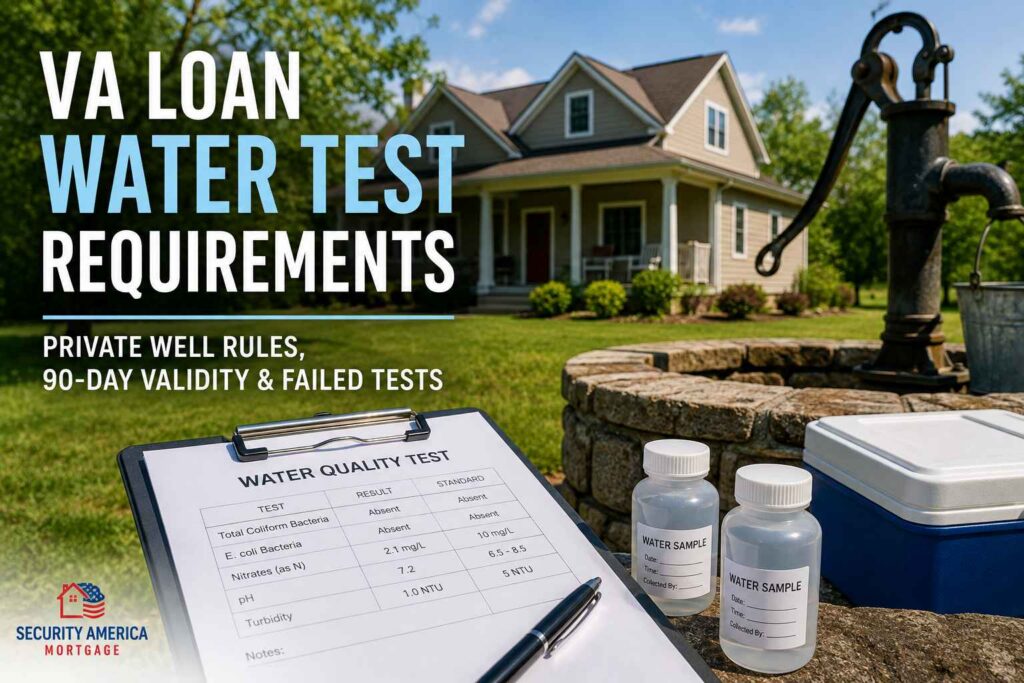
Buying a home with a private well using your VA loan benefit? You’ll likely need a water test before closing. In over 20 years of originating VA loans, I’ve seen more deals slow down over water documentation than almost any other property condition.
The VA water test requirement comes down to four things: your water source, the local health authority’s standard, who collects the sample, and how old the report is. There’s no single national contaminant list, no fixed national price, and no permission to collect the sample yourself. Get those four things right and the water condition clears without drama.
Miss any one of them and you’re paying for a second test, or worse, losing closing time on an entirely fixable problem. I’ve seen veterans order the wrong panel, self-collect the sample, and let a valid report expire — every one of those mistakes cost time and money that a five-minute conversation with the lender would have prevented. Here’s everything you need to know before anyone touches that sample bottle.
Quick Answer: Does a VA Loan Require a Water Test?
A separate VA water-quality test is typically tied to an individual or shared water supply rather than a normal regulated public-water connection. The test must satisfy the applicable health-authority standard, and the Veteran, buyer, seller, real estate agent, or another interested party should not collect or transport the sample.
VA guidance treats the result as valid for 90 days unless the local health authority says otherwise. If a test fails, the transaction is not automatically dead; the issue usually must be corrected, documented, and retested before the lender can clear the property condition.
What Is a VA Loan Water Test?
A VA loan water test is documentation that an individual or non-public water supply meets the water-quality standard applicable to the property. It is part of the VA Minimum Property Requirement framework that requires a home to have a continuous supply of safe and potable water for drinking, bathing, showering, and sanitary use.
The water test is not the same thing as the VA appraisal and it is not a substitute for a private home or well inspection. The appraiser identifies the water source and reports relevant conditions, while the lender and Staff Appraisal Reviewer determine what evidence must be obtained before the loan can close.
while the lender and Staff Appraisal Reviewer determine what evidence must be obtained before the loan can close. Understanding the VA home appraisal process helps borrowers distinguish what the appraiser evaluates versus what the water test covers.
For the broader property review, see Security America Mortgage’s VA Loan Inspection Requirements guide and VA Minimum Property Requirements guide.
Why Does VA Care About Water Quality?
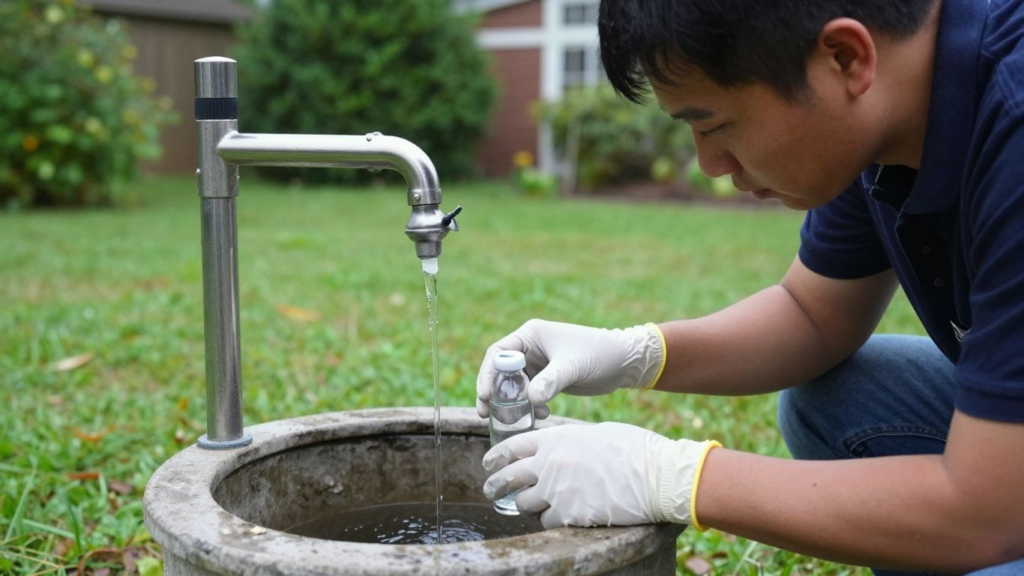
Safe drinking water is a health and sanitation issue, not just an appraisal detail. A property can be structurally sound and still fail VA property requirements if the only household water source is unsafe or cannot provide a reliable supply.
Private wells are different from regulated public systems because water quality can change with groundwater conditions, nearby contamination, well construction, flooding, septic problems, treatment-system maintenance, and other local factors. A laboratory report gives the lender objective documentation that the specific water supply meets the required standard at the time of testing.
When Is a VA Water Test Required?
The water source is the starting point. A home served by an individual well, shared well, or other non-public supply receives a different review from a home connected to a public or regulated community system.
The appraiser’s report and Notice of Value can identify a water or sewage acceptability condition, but the lender should confirm the exact testing and documentation requirements before the buyer orders a lab panel. Local health rules can change the scope.
Private Well or Individual Water Supply
A private well serving one property is the most common VA water-test scenario. The water must meet the applicable health-authority standard and the sample must be collected and transported by an acceptable disinterested third party.
The appraiser also considers the relationship between the well and potential pollution sources. VA does not require the appraiser to sketch every distance, but local health or building rules can still control acceptable well placement.
Shared Well
A shared well can be eligible, but VA requires more than acceptable water quality. The system must be capable of supplying safe and potable water to each property simultaneously in sufficient quantity for normal domestic use.
The shared well must also be protected by a permanent maintenance-and-repair easement and a recorded well-sharing agreement that binds the parties and successors in title and addresses repair costs. The lender must obtain and review that agreement.
Public or Regulated Community Water
A normal public-water property usually does not go through the same individual-well sample process. Public and community supplies are reviewed under their own VA property standards, and community systems require evidence that the water quality is approved by the local or state health authority.
If public water is available but the property uses a private system, VA does not automatically force a connection. Connection becomes required when the local authority mandates it.
New Construction and Existing Homes
New construction does not automatically remove individual-water requirements. A newly completed home on a private or shared well still needs acceptable water documentation before the lender can clear the water-supply condition.
For an existing home, an old report may be useful background, but it does not automatically satisfy a new VA transaction. The 90-day validity rule and any stricter local requirement control whether a new sample is needed.
Which Water Sources Need Special VA Acknowledgement?
Some water sources can be acceptable but require the appraiser to comment and the Veteran to acknowledge the condition in writing. That extra step exists because the supply or treatment method requires more homeowner awareness than a conventional drilled well or public utility.
- Dug wells. The appraiser must report the condition and the Veteran must acknowledge awareness.
- Cisterns or holding tanks with hauled water. The Veteran must acknowledge the non-standard supply arrangement.
- Mechanical chlorinators. A written acknowledgement is required because the water depends on continuing treatment.
- Springs, lakes, and rivers. The source must still meet health-authority water-quality requirements and requires acknowledgement.
- Sand-point or artesian wells. These supplies require the same written awareness process.
- Rainwater catchment systems. The appraiser must comment and the Veteran must acknowledge the source in writing.
A special acknowledgement does not by itself mean the property is ineligible. It means the source has additional documentation and ongoing-use considerations that should be understood before closing.
Who Is Allowed to Perform the VA Water Test?
This is one of the most important rules in the entire process. VA requires individual-water testing to be performed by a disinterested third party, and that rule applies to both collecting the sample and transporting it from the source.
The Veteran or another interested party in the transaction should not collect the bottle, drive it to the lab, and expect the result to satisfy VA. The acceptable party can be the local health authority, a commercial testing laboratory, a licensed sanitary engineer, or another sampler acceptable to the local health authority.
- Confirm the sampler before the appointment. Ask the lender whether the laboratory collects its own samples or uses an approved third-party sampler.
- Do not self-sample for the VA file. A homeowner or buyer-collected sample may be useful for personal information but can fail VA documentation rules.
- Keep the complete report. The lender needs the certified result, testing date, sample identification, and laboratory information, not a verbal ‘it passed.’
Ordering the correct sampler the first time is one of the easiest ways to avoid paying for a second test.
How Long Is a VA Water Test Valid?
VA guidance states that water-quality test results are valid for 90 days from the date certified by the local health authority unless that authority indicates otherwise. This is more precise than saying that ‘many lenders use 90 days.’
The practical implication is that an early test can expire if the transaction is delayed. If repairs, construction, title problems, or another issue pushes closing outside the acceptable period, the lender may require a new sample and updated result.
Schedule the test early enough to leave room for remediation and retesting, but not so early that a long closing timeline makes the report stale.
What Does a VA Water Test Check For?
VA does not publish one national contaminant list that applies to every private well in every state. The water must meet the requirements of the health authority with jurisdiction, and when that authority has no specific requirements, VA guidance points to EPA drinking-water guidelines.
Depending on the jurisdiction, a required panel may include bacterial indicators, nitrate or nitrite, lead, or other contaminants associated with local groundwater conditions. Those are examples of what a local panel may test, not a universal VA four-item checklist.
- Ask which authority controls. The county health department, state agency, or another authorized health authority may define the test.
- Ask for the exact panel. Do not order the cheapest generic well-water screen before confirming the required contaminants.
- Ask whether the lab must be approved. Some jurisdictions maintain lists of acceptable laboratories or samplers.
- Ask whether water quantity or well performance also needs evidence. Safe water quality and adequate water supply are related but separate property concerns.
- Ask about known local contamination. A documented groundwater issue can expand the testing or treatment documentation needed.
The best report is not the report with the most contaminants. It is the report that tests the correct parameters, comes from an acceptable source, and clearly satisfies the lender’s condition.
VA Water Test Process: Step by Step
The cleanest process starts as soon as the appraiser or lender confirms that the property uses an individual or shared supply. Waiting until the final week of underwriting leaves little room for treatment or retesting.
Step 1: Confirm the water source
Determine whether the property uses public water, a private well, a shared well, a community system, or a special source such as a cistern or spring.
Step 2: Ask which health standard applies
Get the lender’s instructions and, when needed, the local health authority’s required test panel.
Step 3: Select an acceptable disinterested sampler
Use a local health authority, commercial laboratory, licensed sanitary engineer, or other acceptable third party.
Step 4: Collect and transport the sample correctly
The Veteran and other interested parties should not handle the sample for the VA-required test.
Step 5: Complete laboratory analysis
The laboratory tests the sample against the required water-quality parameters.
Step 6: Send the complete certified report to the lender
Provide the full document rather than a screenshot or verbal summary.
Step 7: Address any failed result or missing documentation
Follow the health authority, qualified water professional, and lender instructions for treatment, repair, or supplemental evidence.
Step 8: Retest when required
A new acceptable sample may be needed after remediation or when the original result expires.
Step 9: Obtain final lender clearance
The loan should not close with an unresolved water-supply condition.
VA Water Requirements by Water Source
The comparison below summarizes the main documentation differences. The exact requirements can still vary by jurisdiction, property configuration, and the lender’s underwriting conditions.
Use this table only after confirming the actual water source. A property described as ‘well water’ in a listing may actually be on a shared system, and that changes the paperwork substantially.
- Private well. Focus on third-party water-quality testing, safe potable supply, validity period, and local health requirements.
- Shared well. Add a permanent easement, recorded sharing agreement, repair-cost provisions, and sufficient simultaneous supply.
- Community system. The appraiser notes the system and the lender obtains health-authority approval of the facilities.
- Public utility. Typically handled through public-system documentation rather than an individual-well test.
- Special individual source. Expect appraiser comments, written Veteran acknowledgement, and possibly treatment or maintenance documentation.
The table is intentionally the only major comparison table in this guide because water-source type is the point where a side-by-side view adds the most practical value.
| Water Source | Separate Test? | Who Samples? | VA Validity | Extra Review |
|---|---|---|---|---|
| Private individual well | Usually yes for acceptability | Disinterested third party | 90 days unless local authority says otherwise | Water quality + local/EPA standard |
| Shared well | Yes | Disinterested third party | 90 days unless local authority says otherwise | Easement + recorded agreement + sufficient simultaneous supply |
| Community system | Different approval process | Health-authority/system approval | Per applicable documentation | Lender obtains local/state health approval |
| Public water system | Usually no private-well test | N/A for individual-well testing | N/A | Public-system documentation per local/lender rules |
| Special individual source | May require testing + special review | Disinterested third party | 90 days unless local authority says otherwise | Appraiser comment + Veteran acknowledgement |
If the water source does not fit neatly into one category, ask the lender to resolve the classification before the test is ordered. That can save both time and duplicate laboratory fees.
How Much Does a VA Water Test Cost?
VA does not publish one national water-test price. The amount charged is a local service cost that depends on who collects the sample, which laboratory performs the analysis, how broad the required panel is, travel distance, turnaround time, and whether a second sample is needed.
For that reason, I would not use a generic national ‘$100 to $400’ figure as a rule. A simple local bacterial panel can cost much less than a broad contaminant panel with professional collection and rush processing, while remote properties or specialized testing can cost more.
- Sampling or collection charge. Some labs include collection; others use a separate trained sampler.
- Laboratory analysis. The required contaminant panel is usually the main variable in the price.
- Travel or site-call fee. Rural properties can create additional collection costs.
- Rush processing. Expedited reporting can cost more when the closing deadline is tight.
- Retesting. Treatment or repair can create a second collection and laboratory charge.
Ask for an itemized quote that confirms the laboratory, sampler, required panel, collection method, report turnaround, and whether the result will satisfy the lender before authorizing the work.
Who Pays for the VA Water Test?
Do not assume that VA assigns the water-test invoice to one party in every transaction. The purchase contract, lender’s fee review, local practice, and any seller concessions can affect who ultimately pays.
The buyer and seller should settle the responsibility early, especially when a property is known to use a private well. If the test fails and treatment or well work becomes necessary, the repair obligation can become a separate negotiation from the original testing fee.
Before scheduling the test, ask the loan officer or settlement team how the fee should be documented and whether any proposed seller payment or credit fits the final VA closing-cost structure.
What If the Property Uses a Water Filtration or Treatment System?
A filtration or treatment system does not automatically make a property ineligible. When the property depends on treatment to keep water safe for human consumption, VA requires the Veteran to acknowledge in writing that the water must be continuously treated as required by the local health authority.
The system also needs ongoing inspection and maintenance, including filter replacement according to the manufacturer’s recommendations. If a failed test is corrected by installing or repairing treatment equipment, the lender may require evidence of the work and a new acceptable test.
What Happens If the VA Water Test Fails?
A failed result means the water does not meet the standard being applied to the property or the submitted documentation is not acceptable. It does not automatically mean the Veteran has to walk away from the purchase.
The next step depends on what failed. A bacterial issue may have a different remedy from a chemical contaminant, damaged well component, treatment-system failure, or sampling error. The lender should not clear the condition until the appropriate authority or qualified professional has addressed the problem and the required evidence is complete.
- Identify the failed parameter. Use the certified laboratory report, not a verbal summary.
- Confirm the required remedy. Follow the local health authority and qualified water professional rather than applying a generic treatment.
- Complete treatment or repair. The seller, buyer, or another responsible party handles the work according to the contract and lender rules.
- Retest with an acceptable third party. The new sample must still follow VA collection and transport rules.
- Send the new report and repair evidence to the lender. The underwriter or SAR must be able to clear the water condition.
- Extend the contract if necessary. A repair and retest can take longer than the original contingency period.
A failed water test becomes most disruptive when it is discovered just before closing. Testing early gives the parties time to fix a curable problem instead of turning it into an emergency extension.
Private Well vs. VA Appraisal vs. Home Inspection
These three reviews overlap, but they are not interchangeable. The VA appraisal evaluates market value and Minimum Property Requirements. The required water test documents water quality when an individual supply needs acceptance. A private home or well inspection goes deeper into condition, equipment, and long-term ownership risk.
A passing VA water test does not tell you whether the pressure tank is failing, the pump is near the end of its life, the casing is damaged, or the well will meet your household’s long-term needs. Buyers of rural properties should consider a separate well inspection when those risks matter.
Security America Mortgage’s VA Appraisal Checklist explains how the required appraisal fits into the broader property review.
How to Avoid VA Water-Test Delays
Most water-test delays are preventable. Problems usually happen because the wrong person collected the sample, the wrong panel was ordered, the report expired, or the test was left until underwriting was almost complete.
- Confirm the water source immediately. Do not wait for the final appraisal review if the listing already says private or shared well.
- Ask the lender for the exact condition. Know whether the file needs a water-quality test, shared-well agreement, health-authority approval, acknowledgement, or several items.
- Use a disinterested third party from the start. Do not risk a rejected self-collected sample.
- Verify the panel before paying. The cheapest lab package is useless if it omits a locally required contaminant.
- Watch the 90-day validity period. Coordinate the test with the expected closing timeline.
- Send the full report promptly. Do not wait for the lender to chase a lab certificate.
- Leave time for retesting. A result that fails on the first attempt can still be resolved if there is enough contract time.
The best water-test strategy is to treat the test as a planned property condition, not as a surprise document request at the end of underwriting.
Common VA Water Test Mistakes to Avoid
The most common mistakes come from applying generic well-water advice to a VA transaction without checking the current VA documentation rules. The quality test, sampler, source type, and timing all matter.
If you remember only one rule, make it this one: confirm the exact lender condition before anyone touches the sample bottle.
Final Verdict: VA Loan Water Test Requirements in 2026
VA water-test requirements come down to the water source, the health-authority standard, the independence of the sampler, and the age of the report. For an individual or shared well, the safest approach is to confirm the required panel first, use an approved disinterested third party, and deliver the complete certified report to the lender while it is still within the applicable 90-day window.
The most important corrections to generic well-water advice are that there is no single nationwide VA contaminant list, no nationwide VA test price, and no permission for the Veteran or another interested party to handle the required sample. Shared wells and unusual water sources can also require extra legal or written documentation beyond the lab result.
Buying a Home With a Private or Shared Well? Security America Mortgage can review the property type, VA appraisal condition, water-source documentation, and loan file before closing deadlines become tight. Start your VA loan application or call (855) 701-2816.
Frequently Asked Questions
Is a water test required for every VA loan?
No. The individual-water testing requirement most commonly applies when the property uses a private well, shared well, or another individual water supply. Public and community systems follow different documentation rules.
Can the Veteran collect the water sample?
No for the VA-required individual-water test. VA requires a disinterested third party to collect and transport the sample.
Who can perform a VA well water test?
The sample may be handled by the local health authority, a commercial testing laboratory, a licensed sanitary engineer, or another party acceptable to the local health authority.
How long is a VA water test valid?
VA guidance states that water-quality test results are valid for 90 days from certification unless the local health authority indicates otherwise.
What contaminants does VA require in the water test?
VA does not publish one universal national contaminant panel. The water must meet the standard of the health authority having jurisdiction; when no specific local standard exists, VA guidance points to EPA guidelines.
Does a home on public water need a VA well test?
Usually not the same individual-well test. Public and regulated community systems are reviewed under separate VA water-supply requirements and local documentation.
Can a shared well qualify for a VA loan?
Yes. In addition to acceptable water quality, VA requires sufficient simultaneous supply, a permanent easement, and a recorded well-sharing agreement that addresses repairs and binds successors in title.
Does VA require a minimum gallons-per-minute well flow?
VA requires a continuous and sufficient supply, but the applicable quantity or flow documentation can depend on the local authority, shared-well arrangement, property type, and lender conditions rather than one simple national GPM number.
Can a VA loan close after a failed water test?
Potentially. The problem generally must be corrected or otherwise resolved, followed by acceptable documentation or retesting before the lender clears the condition.
How much does a VA water test cost?
VA does not set one national test fee. Cost depends on the sampler, laboratory, location, required contaminants, travel, turnaround time, and whether retesting is needed.
Can a filtration system make well water acceptable for a VA loan?
Treatment systems can be part of an acceptable water-supply setup when the applicable health requirements are met. VA requires written Veteran acknowledgement when continued treatment is necessary and expects ongoing maintenance according to the system requirements.
Do I still need a home or well inspection if the water test passes?
A passing water test only addresses the required water-quality condition. A separate home or well inspection can evaluate pumps, tanks, pressure, visible defects, and other ownership risks that the VA water test does not cover.