

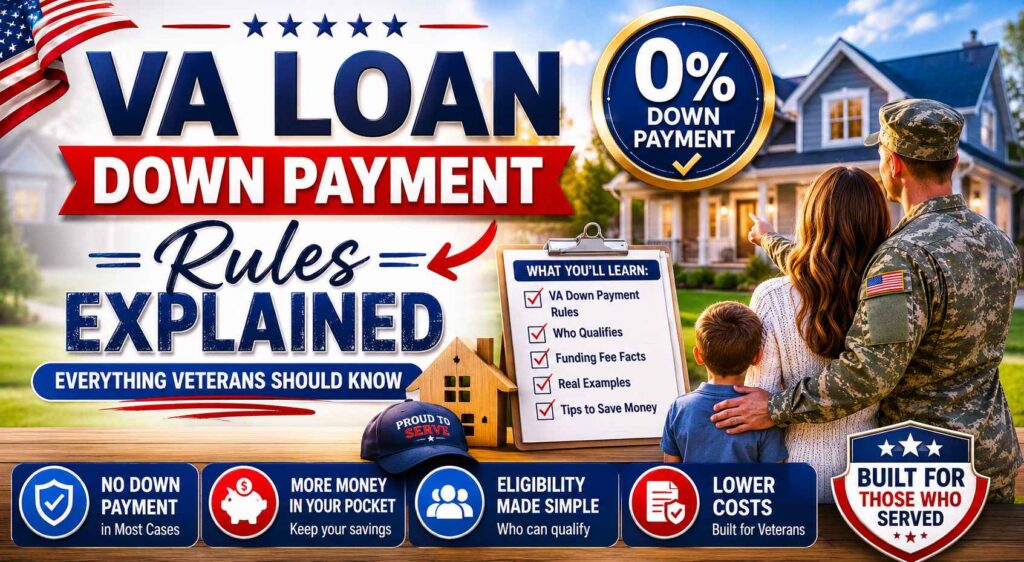
Buying a home is a big deal, right? For many Veterans, the VA loan is a fantastic way to make that happen. But there’s often confusion about putting money down. Do you have to? How much?
This article breaks down the VA loan down payment rules so you know exactly what’s what. We’ll cover eligibility, when a down payment might be needed, and even the pros and cons of putting some cash in upfront. Let’s get this sorted out.
What Is a VA Loan?
So, what is a VA loan? In essence, A VA loan is a mortgage made by private lenders and backed by the U.S. Department of Veterans Affairs for eligible Veterans, service members, and certain surviving spouses. Consider it as a means of helping the people who have served our country.
The VA does not actually make these loans, but rather, they are made by private lenders such as banks and mortgage companies. The VA’s job is to ensure that a part of the loan is guaranteed. This guarantee is essentially a form of insurance for the lender, which makes them more likely to be willing to provide better terms to borrowers.
What are the terms for which we speak? Well, there are some pretty sweet benefits to VA loans:
- In most cases, there is no down payment required. This is a significant one for many.
- VA loans often offer competitive interest rates, but your final rate depends on your lender, credit profile, income, market conditions, and loan details.
- No private mortgage insurance (PMI). This can save you a lot of money every month.
- Limited closing costs, and sometimes some of them are paid by the seller.
- The loan can not only be used to purchase a home, but also to construct a home or renovate or modify an existing home.
It’s not just a one-shot; it’s a benefit that can be used throughout your life. It’s all about making home ownership more attainable for those who have served.
The VA loan benefit is a strong tool that can assist military members and veterans in attaining homeownership at more favorable financial conditions than they can discover in the marketplace. It is government-backed, which means that it is less risky for lenders, and you can enjoy better loan terms.
Overview of VA Loan Down Payment Rules
One of the best things about VA loans for many is that they can purchase a home without any money down. It’s a pretty sweet deal, particularly when contrasted with standard loans that frequently require a lot of cash up front.
Yes, Most eligible borrowers with full VA loan entitlement can buy with no down payment when the lender approves the loan and the home appraises for the purchase price.. This is an old benefit that not everybody is aware of. Many Veterans may not realize that they can forgo the down payment.
Knowing what VA loan requirements are includes knowing that you may not need a down payment, but it’s not impossible. This usually comes into play if your entitlement is affected, perhaps from a previous VA loan that went into default.
Those are the times when, for borrowers without full entitlement, county loan limits can affect how much VA will guarantee and whether a lender may require a down payment
Here’s a quick look at how the VA loan funding fee can change based on your down payment:
| Down Payment Amount | First-Time VA Loan Buyer | Return VA Loan Buyer |
|---|---|---|
| 0% Down | 2.15% | 3.3% |
| 5% or more | 1.5% | 1.5% |
| 10% or more | 1.25% | 1.25% |
It’s also important to note that the VA does not have down payment assistance programs of its own, but there are third-party programs that may be able to help if you choose to put down a down payment for other reasons. Keep in mind that while the down payment may be $0, you’ll have other closing clost costs with a VA loan that you’ll need to understand.
Without a required down payment, homeownership is much more affordable for Veterans. It means that you need less money in the beginning, which will leave you with more savings for other needs or investments. This is one of the reasons why VA loans are so popular among those who qualify for them.
Who Is Eligible for VA Loan Down Payment Benefits?
So, who is eligible to benefit from the VA loan’s huge benefit – the no-down-payment option? Basically, it is about your rights. Most Veterans and active-duty service members who have never utilized their VA loan benefit or have used their VA loan and paid off their previous VA-backed loan have what’s known as “full entitlement. This means that you can typically purchase a home with no down payment. With full entitlement, VA does not set a loan limit for no-down financing, but the lender must still approve the loan amount, and the home must appraise for enough value.
However, things can get a little different if you don’t have full entitlement. This is typically the case when you’ve previously obtained a VA loan and either defaulted on it or are still paying off a mortgage on a home you currently own. In these cases, you might still be able to get a VA loan, but you may need to make a down payment. The amount of that down payment will depend on the price of the home and how much you still have to put in. But it’s not as difficult as it may seem; lenders who are familiar with VA loans can help you work it out.
Let’s take a quick look at who typically qualifies for this $0 down payment benefit:
First-time VA loan borrowers: If you are a first-time VA loan borrower, you will likely have 100% entitlement and no down payment required.
Veterans who have used the benefit in the past but have paid off their VA loan or sold the home: Your entitlement can be restored to use the $0 down payment feature again.
Active-duty: Active-duty service members typically have full entitlement, just like first-time users.
National Guard and Reserve members: Eligibility rules apply based on service length and activation status. Review whether a reservist can get a VA loan for specific Guard and Reserve qualification details.
Eligible surviving spouses and dependent family members: Review if a father was a veteran whether family can get a VA loan for dependent and surviving spouse eligibility specifics.
Down payment eligibility for VA loans is directly related to your service and your entitlement status. It’s a benefit you’ve earned by your service, and knowing the ins and outs of your VA loan benefits is important to effectively use them.
If you are not sure about your particular situation, it is best to speak with a VA loan specialist to obtain clear answers regarding how to utilize VA loan advantages and what your down payment needs may be. Keep in mind that the intent of the VA loan is to make home ownership possible, and the VA is meant for eligible Veterans.
Is a Down Payment Required for VA Loans?
This is probably the most common question regarding VA loans. Whether or not you need a down payment. The great news is, for many eligible Veterans, the answer is a resounding no. VA loans are well-known for their no-down-payment feature, which is a massive benefit over numerous other types of mortgages. A home can be purchased with 0% down, which means that you don’t need to save up a big lump sum for years before you can even consider homeownership.
This benefit is due to the VA’s guaranty, which insures lenders. Since the VA is responsible for a percentage of the loan, lenders are more willing to provide loans without a down payment. It’s a win-win: veterans have an opportunity to purchase a home, and lenders have lower risk. Many VA borrowers use the program with no down payment, but the exact share changes by year and loan type.
However, there are a couple of situations where a down payment might come into play:
If you have full entitlement, VA does not require a down payment based on county loan limits, but lender approval and appraisal value still matter.
Partial Entitlement: If you do not have your full entitlement (some people may have used it before, or if a previous VA loan defaulted), you may be required to make a down payment. The amount will be based on the size of the loan and the remaining entitlement. This is not a set amount, but is determined by the amount of the loan and your entitlement status.
So, it’s best to know about the entitlement part of the VA home loan, although the best-case scenario is a no-down-payment VA home loan. When you’re considering a VA loan in a particular circumstance, you may be wondering how much down payment you’ll need, and speaking with a VA loan specialist is the best way to receive an answer. They can assist you in determining your eligibility and the choices you have for a no-down-payment VA loan or if you need to make a down payment.
The VA does not provide direct down payment assistance because the program is intended to give the ability to purchase with a 0% down in most cases. There are some third-party programs, but the main advantage is incorporated into the loan. Before considering other types of assistance, you may want to consider a no-down-payment VA loan.
It’s also important to note that even if you can obtain a no down payment VA loan, you may consider making a down payment. This can help you save money on your monthly mortgage payment, save on the VA funding fee, and create equity more quickly. However, if a down payment is not an option, the VA loan is another way to make homeownership attainable.
How the VA Loan Entitlement Affects Down Payment
You’ve heard about VA loans and the incredible $0 down payment opportunity, haven’t you? Well, there’s a little something called VA loan entitlement that plays a role in all of this.
Consider your entitlement as the amount that VA will guarantee to the lender. This is the reason why lenders are able to provide these great terms, including the no-down-payment benefit.
Full Entitlement vs. Remaining Entitlement
Most Veterans receive their full benefit when they begin. The majority of Veterans receive their full benefit at the beginning. This means that you can normally obtain a home loan without a down payment with a home loan that is up to the conforming loan limits. If you have not used your benefit to date or if you have paid off your VA loan in full, you may be eligible for your full entitlement.
But if you have any entitlement left, then it’s a different story. This usually happens in a couple of scenarios:
You have previously owned a VA loan and are still paying it off: When you have a VA loan and are still paying it off, a part of your entitlement is used up. You will be given “remaining entitlement” to use.
You had a default or foreclosed VA loan: If you previously had a VA loan that defaulted or was foreclosed, some of your entitlement may have been used up by the VA to make up the loss. It will be necessary to restore your entitlement to use it again.
The remaining entitlement will impact how much you can borrow without a down payment. It’s not a maximum loan amount per se, but rather a maximum loan amount that the VA will guarantee without requiring a down payment. It’s a little tricky to determine the exact amount on your own, but your loan officer can easily work out your remaining entitlement and what your down payment may be.
The VA is not the lender, but rather a private lender. VA’s job is to ensure a part of that loan. This is what makes lenders feel at ease about providing benefits such as no down payment. Your VA entitlement is your portion of that VA guarantee.
If you’re interested in purchasing a home that exceeds these limits or if you have any entitlement remaining, you may require a down payment. Fortunately, even with a down payment, VA loans can still be competitive in terms of rate and terms. When looking into VA loans, it’s always best to consult with a lender that specializes in VA loans to find out what the implications of your entitlement are on your particular situation and what your down payment options are.
When a VA Loan Down Payment Might Be Necessary
Most people think the big draw of a VA loan is putting zero down, and usually, that’s true. But there are situations where you’ll actually need, or want, to put money down to get things rolling. Let’s talk through those.
Buying a Second Home with a VA Loan
Some vets prefer to hold onto their first home (possibly rent it out) and purchase a second home with a VA loan. While you still have entitlement remaining, lenders determine how much you can get without a down payment. If you are not entitled to the full amount of the second purchase, you may need cash up front to make up the difference.
Here are some reasons why you might require a down payment for this situation:
- Not enough remaining entitlement for the new home’s price.
- You live in a higher-cost county than you qualify for.
- You wish to lower your monthly payment or funding fee.
For most VA loans, you don’t need to put any money down, but in some cases, it may be the only way to make the numbers work – particularly when you’re looking at higher-priced properties or buying a second home.
When beginning the VA loan application process, remember that lenders will also require homeowners insurance for your new home and will require it to be paid a year in advance. Information regarding the coverage and the usual payment methods for this policy is available in the info on homeowners coverage for VA loans.
Therefore, if you do need a VA down payment, it is not required by the VA. It’s simply the math when you take into account how much of your benefit you’ve used, the cost of your new home, and where it’s situated.
Pros and Cons of Putting Money Down with a VA Loan
Veterans often ask, “Should I make a down payment if I don’t have to?” The truth is, even though putting money down on a VA loan is not required, it does have some pros and cons worth weighing.
Pros of Making a Down Payment
- Lower VA Funding Fee: The funding fee helps keep the VA loan program running, but the amount you pay depends on your down payment. Larger down payments lower this fee, sometimes by thousands.
- Smaller Monthly Payments: Less borrowed means less interest and smaller monthly bills. That’s a big deal when you’re factoring in VA mortgage closing costs and other expenses.
- Build Home Equity: Putting money down gives you instant equity. This could make things simpler if you ever want to refinance or if home values fluctuate.
- Better Approval Odds: Sometimes, lenders feel more comfortable when you’ve “got skin in the game,” especially if you’re stretching your VA entitlement or buying in a pricey area.
Cons of Making a Down Payment
- Ties Up Your Cash: Once you put down a chunk of savings, it’s not easily accessible for emergencies, moving costs, or home maintenance.
- Not Always Needed: The zero-down option is a unique VA perk, which means you can buy a home sooner, skipping years of saving.
- Opportunity Cost: Some folks prefer to keep cash for investments, repairs, or future needs rather than using it upfront.
| Down Payment | First Use | Repeat Use |
|---|---|---|
| 0% | 2.15% | 3.3% |
| 5% or more | 1.5% | 1.5% |
| 10% or more | 1.25% | 1.25% |
For a lot of Veterans, starting with zero down feels like the simplest way—especially with big moves and transition costs. Still, it’s smart to know all your choices when planning a home purchase.
Bottom line: While not required, making a down payment can save you money long-term, but it also means committing cash you could use elsewhere. It’s about finding what works for your budget and goals.
How to Apply for a VA Loan with No Down Payment
So, you’re wondering if you can actually buy a house with a VA loan and put zero money down? The good news is, yes, you absolutely can, and it’s one of the biggest perks of this benefit. Most Veterans with full entitlement can finance 100% of the home’s value, meaning no down payment is required.
This is a huge deal when you compare it to other loan types, where a down payment can be a significant hurdle. The VA doesn’t lend the money directly; instead, they guarantee a portion of the loan for private lenders. This guarantee is what allows lenders to offer such favorable terms, including the option for a zero-down purchase.
The VA home buying process for veterans, when aiming for no down payment, is pretty straightforward, though it does involve a few key steps. It’s all about making sure you have your ducks in a row before you start looking at houses.
Here’s a general rundown of how to buy a house with a VA loan without a down payment:
- Get Your Certificate of Eligibility (COE): This is your golden ticket. It proves to lenders that you qualify for the VA loan benefit. You can usually get this online through the VA’s eBenefits portal, or your lender can help you obtain it.
- Find a VA-Approved Lender: Not all lenders are experienced with VA loans. Work with VA loan lenders who specialize in this product. They’ll be able to guide you through the specifics of financing a home with VA loan benefits and understand how to structure a no-down-payment loan.
- Get Pre-Approved: This is a critical step. Your lender will review your finances to determine how much you can borrow. For a no-down-payment VA loan, they’ll focus on your income, credit history, and debt-to-income ratio to ensure you can handle the monthly payments.
- House Hunting: With your pre-approval in hand, you can start looking for a home. Remember, the VA has specific property requirements to ensure the home meets minimum standards for safety, soundness, and sanitation.
- The VA Appraisal and Inspection: Once you find a home, the VA will order an appraisal. This isn’t just about determining the home’s value; it also includes a VA Minimum Property Requirements (MPRs) inspection.
- Closing: If everything checks out, you’ll proceed to closing. Since you’re using the no-down-payment option, you won’t need to bring a large sum of cash for a down payment. Your closing costs will still apply, but they are separate from the down payment.
It’s important to remember that while a down payment isn’t required, your ability to qualify for the loan amount still depends on your overall financial picture. Lenders will assess your capacity to repay the loan, even without an initial cash investment from you. This means maintaining a good credit score and stable income is still very important for securing the loan.
Many Veterans are unaware of this significant benefit, with surveys showing a large percentage not knowing they can buy a home with zero down. By understanding the VA home loan no down payment option, you can make a more informed decision and potentially save years of saving for a down payment. This makes financing a home with VA loan benefits a truly powerful tool for homeownership.
Wrapping It Up
So, there you have it. VA loans are a pretty sweet deal for those who’ve served, especially with that no-down-payment option. It’s a huge benefit that a lot of folks don’t even know about, which is wild. Remember, most of the time, you can skip the down payment altogether if you’ve got your full entitlement. But if you’ve used your benefit before or have partial entitlement, you might need to put some money down.
It’s not super complicated, but it’s good to chat with a lender who knows their stuff about VA loans. They can help you figure out exactly where you stand. Don’t let the details scare you off; this benefit is there to help you get into a home.
Frequently Asked Questions
Do I absolutely need a down payment for a VA loan?
For most Veterans, the answer is no! If you have your full VA loan entitlement, you can buy a home without putting any money down. It’s one of the biggest perks of this home loan benefit. Only if you have partial entitlement, meaning you’ve used some of your benefit before or had a previous VA loan go bad, might you need to put some money down, depending on how much you want to borrow.
What is VA loan entitlement?
Think of VA loan entitlement as your eligibility or your ‘share’ of the VA home loan benefit. When you use your VA loan, a portion of it is guaranteed by the Department of Veterans Affairs. This guarantee protects the lender. If you have your full entitlement, it means you haven’t used up this guarantee, allowing you to borrow the full amount without a down payment. If you’ve used it before or had a foreclosure, you might have ‘remaining entitlement,’ which could mean a down payment is needed.
Can I choose to make a down payment even if it’s not required?
Absolutely! While a zero down payment is a huge advantage, you can still choose to put money down if you want. Making a down payment can lower your VA funding fee (a one-time cost for the loan) and reduce your total loan amount. This means smaller monthly payments and less interest paid over time. It’s a good option if you have the extra cash and want to save money in the long run.
Are there programs to help with a down payment for VA loans?
The VA itself doesn’t offer a specific down payment assistance program because so many Veterans can get a loan with zero down. However, there are other organizations and programs out there that might offer help with down payments. It’s a good idea to talk to a VA loan specialist who can tell you about these third-party options.
How does a down payment affect my VA funding fee?
The VA funding fee is a one-time charge that helps keep the VA loan program running. If you make a down payment, it can actually lower the amount of this fee. The more you put down, the less the funding fee will be. For instance, putting down 5% or 10% can significantly reduce the fee compared to putting down nothing.
What happens if I can’t make a down payment?
Don’t worry! The great thing about VA loans is that you often don’t need a down payment at all, especially if you have your full entitlement. Many Veterans buy homes with zero down. The VA’s guarantee to the lender makes it less risky for them, so they don’t always require that initial payment from you. It’s a major reason why VA loans are so popular.