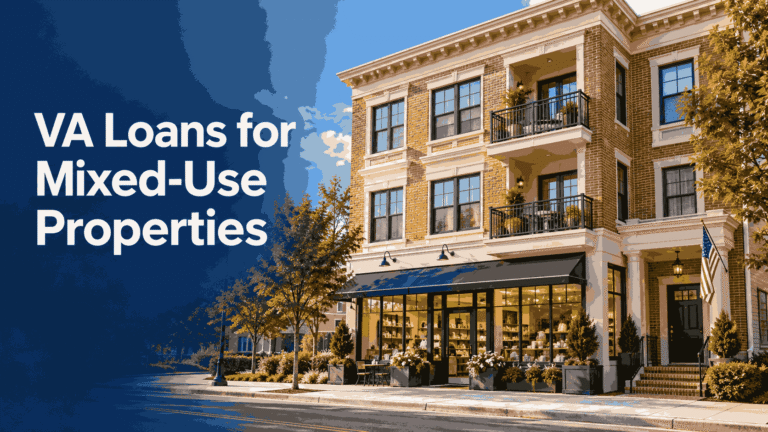


A VA loan can finance some mixed-use properties, but the property must still function primarily as the Veteran’s home rather than as a commercial investment. Under the current VA Lender’s Handbook, a combined residential and business property can qualify only when it is primarily residential, contains no more than one business unit, and the nonresidential area does not exceed 25% of the total floor area.
The business use also cannot impair the property’s residential character, and the existing or planned use must be legally permitted by local zoning or accepted as a legal nonconforming use. Because mixed-use properties are more complex to appraise and underwrite than a standard single-family home, the safest approach is to have the lender review the floor plan, zoning, business activity, occupancy plan, and income assumptions before you make a binding offer.
Quick Answer: What Are the VA Loan Requirements for Mixed-Use Properties?
Yes, a VA loan may be used for an eligible mixed-use property. The current VA baseline requires the property to be primarily residential, limits the property to one business unit, and caps the nonresidential area at 25% of the total floor area. The Veteran must intend to occupy the home as a primary residence, and the property must satisfy zoning, appraisal, Minimum Property Requirements, title, and lender underwriting. The appraiser cannot assign value to the business operation itself or to commercial fixtures.
What Is a Mixed-Use Property?
A mixed-use property combines residential living space with a business or other nonresidential use on the same real-estate parcel. Common examples include a home with a ground-floor storefront, a residence with a professional office, a live-work building, or a house with a small studio or customer-facing workspace.
Mixed-use is not the same as a standard multi-unit residential property. A duplex, triplex, or fourplex can be entirely residential, while a mixed-use property has a commercial or business component. The VA rules for combined residential and business property add a specific one-business-unit limit and a 25% cap on nonresidential floor area.
For the broader property categories VA financing may cover, start with Security America Mortgage’s complete VA loan guide.
Current VA Rules for Mixed-Use Properties

The current VA Lender’s Handbook is more specific than many online summaries. It does not simply say the property should be “mostly residential.” It sets three eligibility conditions for a combined residential and business property, and VA appraisal guidance adds zoning and residential-character requirements.
A lender should evaluate the actual building and proposed use, not just the real-estate listing category. The same property can be treated differently if the floor plan, business unit count, zoning, or intended use changes before closing.
The Property Must Be Primarily Residential
The home must remain the main purpose of the property. A residence with a secondary office or shop can fit that concept, while a business-first building with a small apartment attached may not. The lender and appraiser look at the physical layout and actual use, not just the address or marketing description.
The Nonresidential Area Cannot Exceed 25% of Total Floor Area
This is the most important factual correction to the draft. Current VA loan-purpose guidance explicitly limits the nonresidential area to no more than 25% of the property’s total floor area for a combined residential and business property. Do not rely on a lender-specific guess or an informal “mostly residential” standard when this calculation can be measured.
The Property Can Have No More Than One Business Unit
VA permits no more than one business unit within the combined residential and business property rule. A single office, storefront, studio, or other qualifying business area may be reviewable, but multiple distinct commercial units can make the property ineligible under this rule.
The Business Use Cannot Impair Residential Character
The commercial activity should remain compatible with the property functioning as a home. A quiet office or small professional workspace is easier to reconcile with residential character than a use dominated by heavy equipment, hazardous operations, extensive customer traffic, or commercial infrastructure.
The Use Must Be Legal Under Local Zoning
VA appraisal guidance requires the property to be legally permitted and conform to current zoning, or to be a legal nonconforming use accepted by the local authority. A zoning label alone does not create VA eligibility, but illegal use can create a direct property problem.
The Veteran Must Occupy the Home as a Primary Residence
VA purchase financing is not a general commercial or investment loan. The eligible borrower must certify an intent to occupy the property as a home. VA generally considers occupancy within 60 days after closing reasonable, although documented exceptions can apply in certain circumstances.
The Property Must Still Meet VA Minimum Property Requirements
Mixed-use status does not replace ordinary property standards. The residential portion still needs to satisfy applicable VA Minimum Property Requirements related to safety, soundness, sanitation, access, utilities, water, sewage, structural condition, and other property-specific items.
The Business Operation and Commercial Fixtures Do Not Add Appraised Value
VA appraisal guidance says no value may be assigned to the business operations or commercial fixtures. The appraiser is valuing eligible real estate, not the going-concern value of a business, inventory, specialized equipment, or commercial trade fixtures.
For current property-condition guidance, review Security America Mortgage’s VA Minimum Property Requirements guide and VA loan inspection requirements.
VA Mixed-Use Property Rules at a Glance
Before reviewing the table, treat these as gating questions rather than general preferences. A mixed-use purchase should not move forward on the assumption that the commercial percentage or business-unit count can be fixed later unless the lender confirms an acceptable, legal plan before closing.
The exact measurements and classification may come from the appraisal, plans, zoning records, assessor information, or other property documents. If the listing is unclear, ask for a floor plan and written zoning information early.
- Residential purpose first. The building should function mainly as the Veteran’s home.
- One business unit maximum. Multiple distinct business units create an eligibility problem.
- 25% commercial floor-area maximum. The nonresidential portion must not exceed one quarter of total floor area.
- Legal use required. Current zoning or accepted legal nonconforming status must support the use.
- Residential character preserved. The business activity cannot overwhelm the home use.
The table summarizes the current VA baseline and the evidence a lender may use to verify it.
| Review Area | VA Baseline | What the Lender/Appraiser Checks |
|---|---|---|
| Primary use | Primarily residential | Floor plan, appraisal, actual use, listing/property records |
| Business units | No more than one | Layout, leases, occupancy/use description |
| Commercial floor area | No more than 25% of total floor area | Measured floor plan, appraisal, building records |
| Residential character | Nonresidential use cannot impair it | Appraisal, business activity, layout, site observations |
| Zoning | Legal or accepted legal nonconforming use | Zoning letter, municipal records, appraiser/lender review |
| Occupancy | Veteran intends to use property as home | VA occupancy certification and underwriting |
| Appraisal value | No value to business operations/commercial fixtures | VA appraisal report |
A property that clearly fits every row is easier to underwrite. A property that sits close to the 25% limit, has unclear zoning, or contains more than one commercial suite should be reviewed before the buyer makes a nonrefundable commitment.
Mixed-Use Property Examples: What May Qualify and What Usually Will Not
Examples are useful only when the exact floor area, zoning, and use are known. The same “storefront with apartment” description can describe a VA-eligible home in one building and a commercial-first property in another.
Use the examples below as screening scenarios, not guarantees. The lender and VA appraisal still control the final property decision.
- Potentially workable: home with a small professional office. The office is one business unit, stays under the 25% floor-area cap, is legally permitted, and the Veteran occupies the residential portion as a primary home.
- Potentially workable: residence above one modest storefront. The building remains primarily residential, the storefront is the only business unit, and total nonresidential floor area does not exceed 25%.
- Potentially workable: home with a small studio or workspace. The activity is legal, secondary to the home, and does not impair residential character or safety.
- Likely ineligible: multiple separate commercial suites. The current VA rule allows no more than one business unit for a combined residential and business property.
- Likely ineligible: restaurant or shop occupying more than 25% of floor area. The nonresidential portion would exceed the current VA floor-area limit even if the Veteran lives elsewhere in the building.
- Ineligible purpose: business or investment property with incidental living space. VA purchase financing is intended for an owner-occupied home, not a commercial acquisition whose main purpose is business or investment use.
If the business use is expected to change after closing, disclose the intended use to the lender before approval. A property should not be structured one way for underwriting and then immediately operated in a materially different way.
How the VA Appraisal Works on a Mixed-Use Property
A VA appraisal on a mixed-use property does more than establish market value. The appraiser also provides information the lender needs to determine whether the property remains primarily residential, whether the nonresidential use is compatible with the home, and whether zoning and Minimum Property Requirements are satisfied.
Mixed-use valuation can be harder because comparable sales may be limited. The appraiser should value the real estate that supports the eligible residential purchase and cannot assign value to the operating business or commercial fixtures. Specialized equipment, inventory, goodwill, customer lists, or other business assets are not part of the VA real-estate value.
- Floor-area analysis. The report or supporting documents should make it possible to verify that nonresidential area stays within the 25% cap.
- Business-unit count. The layout should show whether the property has one business unit or multiple distinct commercial spaces.
- Zoning and legal use. The appraiser may note whether the current use conforms to zoning or is an accepted legal nonconforming use.
- Residential character. Access, utilities, layout, noise, traffic, equipment, and commercial use can affect whether the property still functions primarily as a home.
- MPR condition review. The residential property must still meet applicable safety, soundness, sanitation, access, utility, and structural requirements.
- No business-value credit. The appraiser does not increase the VA value because the business is profitable or because commercial fixtures are valuable to the operator.
If the appraisal identifies a classification, zoning, value, or MPR problem, underwriting may need additional documentation, repairs, clarification, or a different property before the loan can close.
For the valuation process, see Security America Mortgage’s VA home appraisal guide and VA appraisal checklist.
VA Occupancy Rules Still Apply to Mixed-Use Properties
The presence of a storefront or office does not change the basic purpose of a VA purchase loan. The eligible Veteran must intend to occupy the property as a home, and VA generally treats occupancy within 60 days after closing as a reasonable timeframe.
A mixed-use property bought solely to rent out the residence, lease the entire building, or operate as a non-owner-occupied business investment does not fit the normal VA purchase purpose. If active-duty orders, deployment, retirement, repairs, or other unusual circumstances affect occupancy timing, discuss them with the lender before closing.
For occupancy scenarios involving military moves, Security America Mortgage also explains VA loans with PCS orders.
Business Use, Self-Employment Income, and Commercial Rent
Property eligibility and income qualification are separate questions. A business can be an acceptable secondary use of the property while the borrower’s business income still needs its own underwriting documentation. Likewise, a commercial tenant can occupy an allowable business space without the lender automatically counting every dollar of lease income for qualification.
If the Veteran operates the business, the income is generally analyzed under VA self-employment rules. The lender reviews tax returns and may require business financial statements, a year-to-date profit and loss statement, a balance sheet, and evidence that the income is stable and likely to continue. VA guidance generally views two years of self-employment as the strongest history, with shorter histories requiring more development.
- Do not count gross business revenue as personal qualifying income. The lender analyzes documented earnings available to the borrower after business expenses and applicable adjustments.
- Do not assume commercial lease income will be treated like residential unit rent. Commercial rental income is more property- and documentation-specific; the lender should confirm exactly what can be used.
- Separate business assets from real-estate value. Business equipment, inventory, and commercial fixtures do not become VA appraised value merely because they are located on the property.
- Expect additional documentation when the business occupies the property. The lender may need leases, business tax returns, ownership records, licenses, insurance information, or a written description of the operation.
- Keep the qualification conservative before an offer. If the deal only works when uncertain business or commercial-rent income is counted, get that income reviewed before you sign a contract.
The cleanest mixed-use approval is one where the property qualifies on its own and the borrower’s income is already documented under normal VA underwriting standards, without relying on assumptions about future commercial income.
For borrower-side underwriting, review the VA loan underwriting guide and VA debt-to-income guide.
What to Verify Before Making an Offer on a Mixed-Use Property
Mixed-use purchases are easiest when the property is screened before the contract is written. A listing agent may call a property “residential with office space,” but the lender needs measurable facts, not marketing language.
- Total floor area and nonresidential floor area. Ask for a floor plan or other reliable measurement so the 25% limit can be reviewed.
- Number of business units. Confirm whether the commercial portion is one unit or multiple separately usable suites.
- Current zoning and legal status. Request municipal or zoning records showing that the current use is legal or accepted as legal nonconforming.
- Actual and planned business activity. Describe what the business does, customer traffic, employees, deliveries, equipment, storage, noise, and operating hours.
- Residential access and utilities. Confirm the home has functional residential access, kitchen, bathroom, utilities, and other features expected of an eligible residence.
- Existing commercial lease. Provide the lease early if a business tenant is already in place so the lender can review use, term, access, and income treatment.
- Insurance availability. Mixed-use occupancy can affect homeowners or commercial insurance requirements, so obtain quotes before the final week of closing.
- Comparable sales. Unusual mixed-use buildings can be harder to appraise; ask whether the local market has comparable mixed-use sales.
- Your occupancy plan. Be ready to explain when you will move into the residential portion and how the commercial area will be used after closing.
A lender review before the offer cannot guarantee final appraisal or underwriting approval, but it can identify obvious eligibility problems before earnest money, inspection fees, and appraisal costs are at risk.
A complete VA pre-approval should be paired with a property-specific review for this type of purchase.
How to Apply for a VA Loan on a Mixed-Use Property

The application should begin with ordinary VA eligibility and financial pre-approval, followed immediately by a property-specific mixed-use review. That order prevents a borrower from confusing personal loan eligibility with property eligibility.
Step 1: Confirm VA eligibility and pull a current COE
Verify military benefit eligibility and entitlement before structuring the purchase. A current COE also helps the lender identify prior VA loan usage or funding-fee status.
Step 2: Complete full VA pre-approval
Submit income, asset, credit, debt, and employment documentation so the lender knows the borrower side of the file is supportable before analyzing an unusual property.
Step 3: Send the property package before the offer
Provide the listing, floor plan, square footage, zoning information, photographs, business-use description, and any existing commercial lease.
Step 4: Calculate the nonresidential percentage
Confirm that the commercial area does not exceed 25% of total floor area. Do not estimate visually if reliable measurements are available.
Step 5: Confirm there is only one business unit
Identify whether the space is one business operation/unit or multiple separate commercial suites.
Step 6: Confirm legal use and insurance
Resolve zoning status and obtain realistic insurance information for the mixed residential-commercial occupancy.
Step 7: Write the offer with appropriate protections
Work with your real-estate professional to address financing, appraisal, inspection, zoning, and property-eligibility risks in the contract where permitted.
Step 8: Complete the VA appraisal and underwriting review
The appraiser and underwriter confirm value, MPRs, floor-area limits, residential character, zoning, occupancy, and the borrower’s final financial qualification.
Step 9: Clear any property or documentation conditions
Respond quickly to requests for zoning letters, lease documents, repairs, business financials, insurance, or appraisal clarification.
Security America Mortgage can pull your COE and, once the property package is ready, you can start the VA loan application.
Documents to Gather for a Mixed-Use VA Loan Review
A mixed-use file usually needs more property documentation than a standard single-family purchase. Gathering the records before the appraisal helps the lender identify whether the building fits the VA baseline and whether any underwriting issue needs to be solved early.
- Current Certificate of Eligibility. Confirms VA eligibility and entitlement status.
- Purchase contract and listing. Shows price, terms, property description, seller concessions, and planned closing date.
- Floor plan or measured layout. Supports the residential-versus-commercial floor-area calculation.
- Zoning documentation. Shows permitted use or legal nonconforming status.
- Business-use description. Explains the nature of the operation, customer traffic, employees, equipment, deliveries, and hours.
- Commercial lease, if applicable. Allows underwriting to review the tenant, use, rent, term, and access arrangements.
- Property tax and insurance information. Mixed-use classification can affect carrying costs and insurance structure.
- Business financials for owner-operated businesses. Self-employed borrowers may need tax returns, profit-and-loss statements, balance sheets, or other supporting records.
- Standard VA borrower documents. Income, employment, bank statements, credit authorization, identification, and service documents still apply.
The goal is to let the lender prove the property meets the VA rule rather than asking the underwriter to infer it from a listing description or a few photographs.
Benefits and Trade-Offs of Using a VA Loan for Mixed-Use Property
A qualifying mixed-use property can let a Veteran combine homeownership with a modest business use while preserving the major benefits of VA financing. The trade-off is a more detailed property review and a smaller pool of buildings that fit the program rules.
The best fit is a home-first property where the business use is clearly secondary, measurable, legally permitted, and easy for an appraiser and lender to understand.
Potential Benefits
- Owner-occupied home plus workspace. A qualifying property can combine the primary residence with a modest office, shop, or studio.
- Potential VA financing benefits. With full entitlement and lender approval, eligible borrowers may receive zero-down financing and no monthly private mortgage insurance.
- One property for home and business use. For the right borrower, a compliant mixed-use property can reduce the need to lease a separate small workspace.
- Possible income flexibility. Documented self-employment or allowable rental income may support qualification when it meets underwriting requirements.
These benefits only matter when the property still satisfies the VA mixed-use restrictions. The business component cannot be allowed to turn the transaction into a commercial loan by another name.
Potential Trade-Offs
- Narrower property eligibility. The 25% floor-area cap and one-business-unit limit exclude many mixed-use listings.
- More complex appraisal. Comparable sales, zoning, commercial features, and floor-area classification can require more analysis.
- Insurance may be more complex. Residential and business activity can change the type or cost of coverage needed.
- Income documentation can be heavier. Self-employment or commercial rental income may require additional underwriting support.
- Lender overlays can matter. A lender may be more conservative about property types that are difficult to appraise, sell, or insure.
If the property barely fits the VA threshold, compare the cost and certainty of a more clearly residential property before spending heavily on due diligence.
What If the Mixed-Use Property Does Not Qualify for a VA Loan?
An ineligible mixed-use property does not mean the borrower is ineligible for VA financing. It means that particular building, use, or structure does not fit the VA home-loan purpose or the lender’s requirements.
- Ask which rule failed. Was the problem the 25% floor-area cap, multiple business units, zoning, residential character, appraisal value, MPRs, occupancy, or a lender overlay?
- Consider a different mixed-use property. A home with a smaller single business area may fit the VA rule even when the first property does not.
- Separate the home and business purchase. Use VA financing for an eligible primary residence and handle a separate commercial property under appropriate business financing.
- Compare non-VA financing. A conventional residential product or commercial/mixed-use loan may allow a property configuration the VA program does not.
- Do not assume a use change fixes the deal. Any proposed change must be legal, completed or documented as required, and accepted by the lender and appraiser before closing.
If the goal is primarily rental or investment income rather than owner occupancy, read Security America Mortgage’s guidance on VA loans for rental property and VA loans for investment property before structuring the purchase.
Mixed-Use Property vs. ADU vs. Multi-Unit Home
These property types are easy to confuse. A business unit is nonresidential space. An accessory dwelling unit is residential space with living facilities. A duplex, triplex, or fourplex is a multi-unit residential property. The classification matters because different appraisal and underwriting rules apply.
If the extra space has a kitchen, bathroom, and sleeping area rather than a business use, the property may need to be analyzed as an ADU or multi-unit residential property instead of mixed-use. That classification should be resolved before relying on the 25% commercial-space rule.
For residential accessory space, see the VA loan for an ADU guide. For one-to-four-unit VA purchases, the complete VA loan guide explains the owner-occupancy framework.
Common VA Mixed-Use Property Mistakes to Avoid
Most mixed-use VA problems start before the appraisal, when buyers assume the property is eligible because it has a bedroom, is zoned for residential use, or was described as “live/work.” The current VA rules are more specific than those labels.
- Ignoring the 25% floor-area cap. The current VA Lender’s Handbook expressly limits nonresidential area to 25% of total floor area.
- Assuming “primarily residential” is the only test. The property must also have no more than one business unit and meet zoning and residential-character requirements.
- Making an offer before the lender sees the layout. A mixed-use listing should be screened with floor-area and business-use details before the buyer is deeply committed.
- Treating zoning approval as mortgage approval. Legal zoning is necessary, but it does not replace VA property eligibility, appraisal, MPRs, or underwriting.
- Counting business fixtures in value. VA appraisal guidance does not give value to business operations or commercial fixtures.
- Assuming future business income will qualify. Self-employment or commercial rent must be documented and accepted by underwriting before it should be used in the budget.
- Using VA financing for a business-first investment. The property must remain an owner-occupied home, not a commercial purchase with incidental living space.
- Confusing an ADU with a business unit. Residential accessory space follows a different classification path and should be identified correctly.
- Waiting until the appraisal to check insurance. Mixed-use activity can affect coverage and should be discussed with an insurer early.
- Assuming every VA lender has identical overlays. VA sets the baseline, but lender appetite for complex or unusual mixed-use properties can differ.
A clean mixed-use transaction starts with measurable facts: floor area, one business unit, legal use, owner occupancy, residential character, and a property that can be appraised as eligible residential real estate.
Final Verdict: Can a VA Loan Finance a Mixed-Use Property?
Yes, but the current VA rules are specific. A combined residential and business property must remain primarily residential, contain no more than one business unit, and keep the nonresidential area at or below 25% of total floor area. The business use must not impair the residential character, and the use must be legally permitted or accepted as legal nonconforming.
The Veteran must also meet the normal occupancy and underwriting requirements, while the property must pass the VA appraisal and applicable Minimum Property Requirements. Because the appraiser cannot give value to the operating business or commercial fixtures, buyers should evaluate the real estate and business economics separately.
For a mixed-use purchase, the best next step is not to guess whether the property qualifies. Send the floor plan, zoning, business-use details, and occupancy plan to a VA lender before the offer so the property can be screened against the current rules.
Have a Mixed-Use Property You Want Reviewed? Security America Mortgage can review your VA eligibility and the property details before you move deeper into the purchase. Start your VA loan application or call (855) 701-2816. Property and product eligibility remain subject to full lender and VA review.
Frequently Asked Questions
Can you use a VA loan for a mixed-use property?
Yes, if the property is primarily residential, has no more than one business unit, keeps nonresidential area at or below 25% of total floor area, satisfies zoning and property requirements, and the Veteran will occupy it as a home.
What percentage of a VA-financed property can be commercial?
Current VA loan-purpose guidance limits the nonresidential area to no more than 25% of the total floor area for a combined residential and business property.
How many business units can a VA mixed-use property have?
The current VA rule allows no more than one business unit in the combined residential and business property.
Can I buy a building with a storefront and apartment using a VA loan?
Potentially, if the storefront is the only business unit, the building remains primarily residential, the commercial area is no more than 25% of total floor area, the use is legal, and the property passes appraisal and underwriting.
Does mixed-use zoning automatically make a property VA eligible?
No. Zoning is only one part of the review. The property must also satisfy the VA residential-purpose, business-unit, floor-area, occupancy, appraisal, MPR, title, and lender requirements.
Can the Veteran operate the business in the commercial space?
Potentially. The business use must be legal, secondary to the residential use, within the space limits, and compatible with the property’s residential character. The lender also reviews any self-employment income separately.
Can a commercial tenant occupy the business space?
Potentially, but the lease, tenant use, zoning, property classification, and any income used for qualification need lender review. Do not assume all commercial rent can automatically be counted.
Can business income help qualify for the VA loan?
Yes when it meets VA and lender self-employment income requirements. The lender typically analyzes tax returns and other business financial documentation rather than using gross business revenue.
Does the VA appraiser value the business?
No. VA appraisal guidance says no value may be assigned to the business operations or commercial fixtures. The appraisal is for eligible real estate value.
Does the Veteran have to live in the mixed-use property?
Yes for a normal VA purchase. The borrower must intend to occupy the property as a primary residence, subject to the VA occupancy rules and permitted exceptions.
Can a VA loan finance a property with two storefronts?
A property with more than one business unit would not satisfy the current VA mixed-use rule for combined residential and business property.
Should I get pre-approved before making an offer on a mixed-use property?
Yes. Get borrower pre-approval and then send the exact property details for a mixed-use eligibility review before making a firm commitment.